Simple Patterns for Preschoolers: The First Step to Math Thinking
The other morning my daughter lined up her breakfast without being asked: strawberry, blueberry, strawberry, blueberry, all the way across her plate. She wasn’t doing “math” in any way she’d recognize, but she absolutely was. That small, satisfying act of making something repeat is one of the earliest signs a young child is starting to think like a mathematician.
Patterns are quiet, and they’re easy to overlook next to counting and letters. But they may be the most useful early-math skill of all, and the good news is you already have everything you need to teach them scattered around your house.
Why patterns matter for early math (and reading)
A pattern is simply something that repeats in a predictable way: red, blue, red, blue, or clap, stomp, clap, stomp. When a child notices that repetition and can guess what comes next, something big is happening in their thinking. They’re learning that the world is orderly, that things follow rules, and that they can use what they already see to predict what they can’t yet see. That skill of “figuring out the rule” sits underneath nearly all of math.
Patterns lead directly into counting (1, 2, 3 is a pattern), skip counting, addition, and eventually multiplication and algebra. Long before a child solves “2 + __ = 5,” they’re doing the same kind of reasoning when they fill the gap in red, blue, red, ___, red, blue.
Patterns help with reading, too. Recognizing that letters make predictable sounds, that stories have a beginning-middle-end shape, and that words follow rhythms all lean on the same pattern-spotting muscle. So when you play with patterns, you’re quietly supporting both sides of your child’s learning at once.
What pattern skills look like by age 3, 4, and 5
Children grow into pattern thinking gradually, and there’s a wide, healthy range. Here’s roughly what to expect, so you can meet your child where they are rather than push.
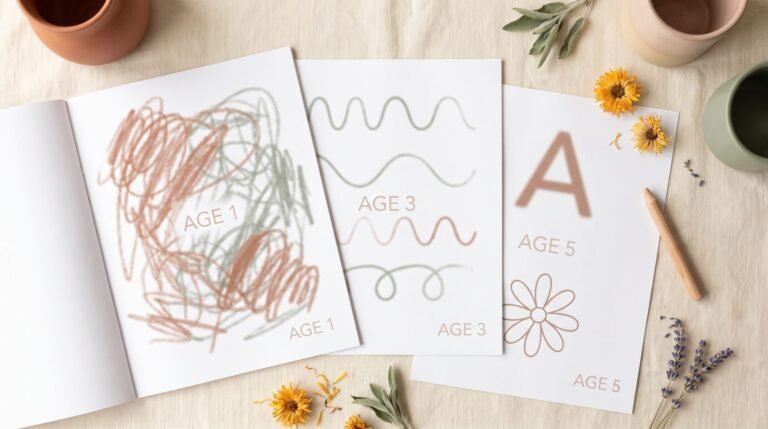
- Around age 2-3: Most children are sorting and matching first. They’ll group all the red blocks together or find the sock that matches. They may copy a very simple pattern you make (like “big, small, big, small”) with your help. Sorting is the doorway to patterning, so this stage matters.
- Around age 4: Many children can copy an AB pattern on their own and start to extend it, adding the next few pieces without help. They begin to notice patterns out in the world, on clothes, tiles, and fences, and love pointing them out.
- Around age 5: Children often create their own patterns, fix a pattern with a mistake in it, and handle more complex ones like ABC or ABB. Some start describing the rule out loud: “It goes circle, circle, square.” That ability to name the rule is a real leap.
If your child isn’t doing these exactly on schedule, that’s completely normal. These are gentle signposts, not a checklist, and playful practice moves things along far better than pressure ever could.
Starting with simple AB patterns using real objects
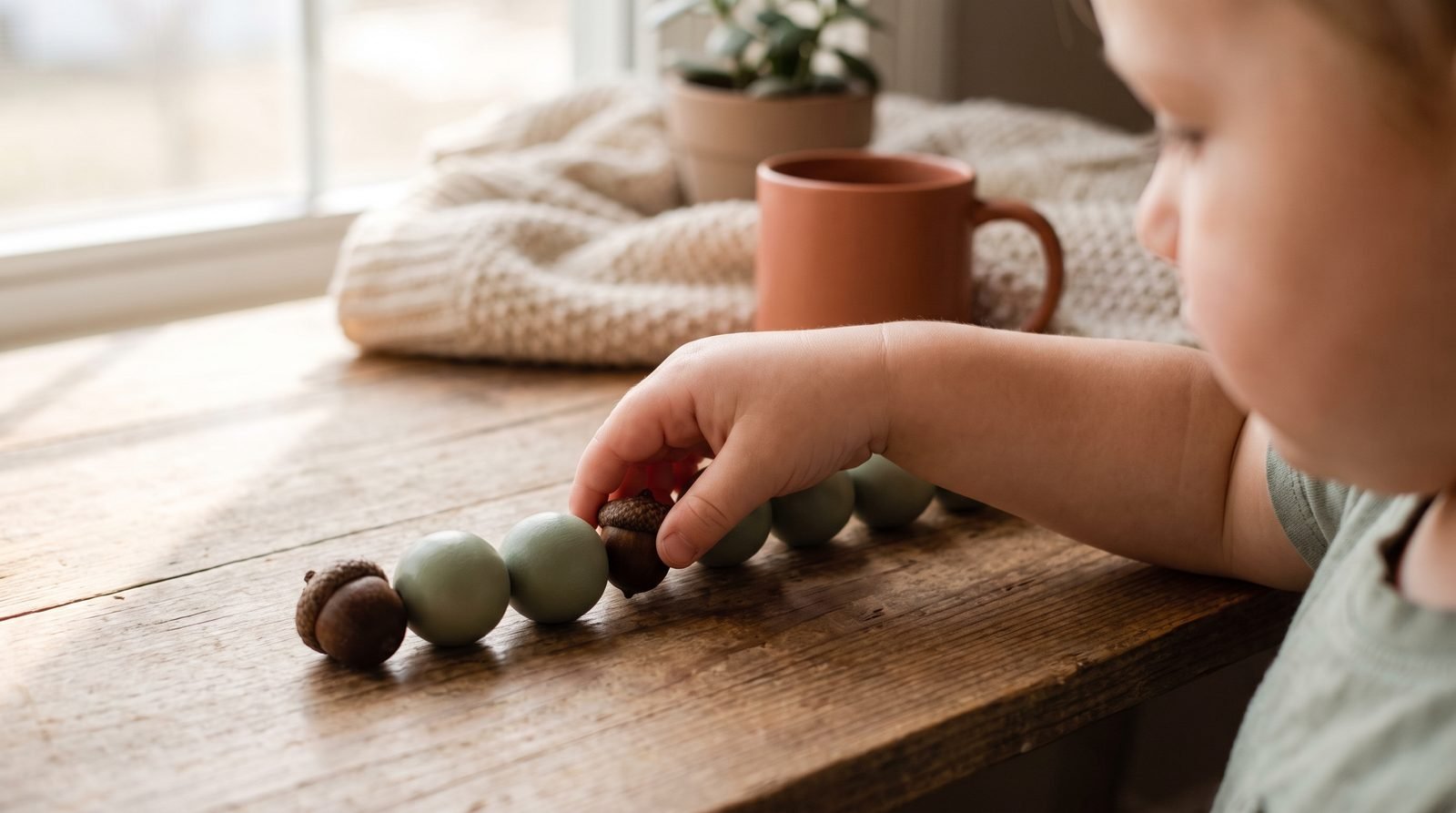
The best first patterns are things a child can touch, move, and rearrange. Physical objects let them feel the rhythm of a pattern and fix mistakes easily, which a worksheet can’t do yet. Gather a small handful of two different items: two colors of blocks, spoons and forks, pom-poms and buttons, acorns and pebbles. Almost anything works. One quick note for the youngest crowd: if your two-year-old still mouths things, skip small parts like buttons, beads, or pebbles and use larger, safe objects such as big blocks or spoons instead, always within arm’s reach.
Then build the skill in this order, which follows how children actually learn:
- Copy: You make a short AB pattern (red, blue, red, blue) and invite your child to build one just like it right underneath. Copying comes first.
- Extend: You start the pattern and stop mid-way. Ask, “What comes next?” and let them continue it. This is where prediction kicks in.
- Fix: Build a pattern with one deliberate mistake and say, “Uh oh, something’s not right here, can you find it?” Children love being the pattern detective.
- Create: Finally, hand over the pieces and let them invent their own. Ask them to “read” it back to you out loud.
Keep sessions short and light, just a few minutes. Narrate as you go (“red, blue, red, blue, what’s hiding next?”) so your child hears the rhythm. That spoken beat is doing a lot of the teaching. For more hands-on ideas in this spirit, our roundup of best pre-K learning activities at home pairs nicely with pattern play.
Moving to ABC and growing patterns
Once AB patterns feel easy, usually somewhere in the 4-to-5 range, you can gently stretch things. Don’t rush this; a child who’s solid on AB is far better set up than one who was hurried through it.
Try these next steps, one at a time:
- ABC patterns: Three elements instead of two, like red, blue, yellow, red, blue, yellow. It sounds small, but holding three items in mind is a real step up.
- ABB or AAB patterns: Same two items, new rhythm, like red, blue, blue, red, blue, blue. This teaches that the rule matters, not just the pieces.
- Growing patterns: Patterns that get bigger in a steady way, like one block, then two, then three, then four. Building a “staircase” of blocks is a wonderful, tactile introduction and a direct bridge to number sense and counting.
Growing patterns are especially powerful because they connect patterning straight to numbers. If you’re also working on counting, you’ll find these ideas reinforce each other beautifully, and our guide to teaching numbers at home is a natural companion here.
Spotting patterns in everyday life
You don’t need a special activity to teach patterns. Once you start looking, they’re everywhere, and pointing them out in real life helps a child understand that patterns aren’t a school thing, they’re a world thing.
- Getting dressed: Notice the stripes on a shirt or the pattern on socks.
- In the kitchen: Lay soft fruit like banana coins and blueberries in a pattern on the plate, or set the table spoon, fork, spoon, fork. Save skewers and toothpicks for older preschoolers only, and even then use them together and supervised; for toddlers, keep foods soft and cut small to avoid choking.
- On a walk: Look at fence posts, brick walls, tiles, and railings.
- With sound and movement: Clap-clap-stomp, clap-clap-stomp. Patterns you can hear and feel are just as real as ones you can see.
- In routines: Bath, book, bed every night is a pattern too, and naming it helps your child feel the predictability they crave.
A simple “Look, that’s a pattern!” a few times a day does more than any single sit-down lesson. You’re teaching your child to see the structure hiding in ordinary things.
When printable pattern practice helps
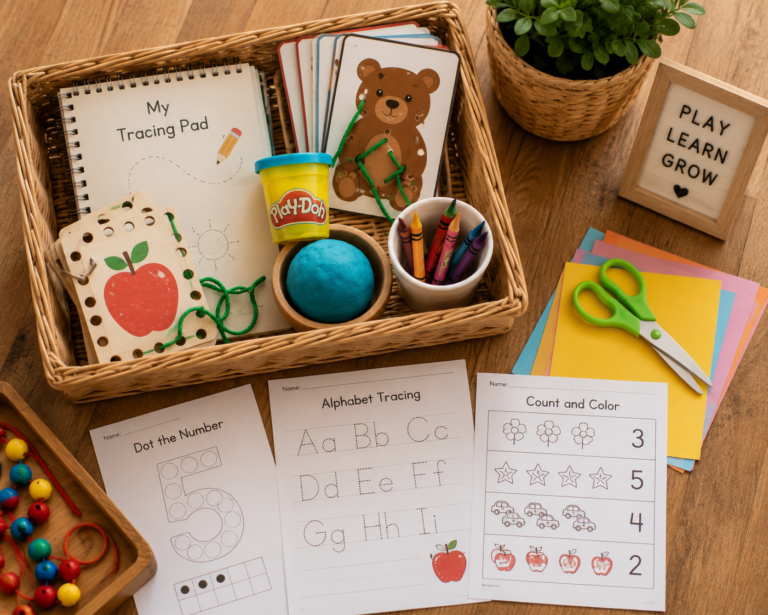
Hands-on play should always come first, but there’s a natural moment when a printable page becomes genuinely useful, usually once your child can already copy and extend AB patterns with real objects. At that point, a worksheet does something specific: it asks the child to work with patterns drawn on paper rather than moved by hand, which is a small step toward more abstract thinking.
Printables also help in practical ways. They give a clear “finish line,” they’re easy to pull out when you need five calm minutes, and they let a child practice tracing, coloring, and fine-motor control while they pattern. The trick is to keep them low-pressure: one page, no timer, plenty of “You figured out the rule!” If your child stalls, drop back to real objects for a bit, then try again another day. A good printable simply mirrors the copy-extend-create path you’ve already built by hand, so it reinforces the real-object work rather than replacing it.
Playful pattern games with no worksheets
If your child isn’t in a paper mood, or you just want to keep things moving, these need nothing but the two of you:
- Sound patterns: Make a rhythm with your voice or hands and have your child echo it, then let them lead.
- Body patterns: Stand, sit, stand, sit, or hop, spin, hop, spin. Great for wiggly days.
- Snack patterns: Arrange soft, bite-sized foods like banana coins and berries in a pattern, then eat them in order. For toddlers, cut round foods small and stay close while they eat.
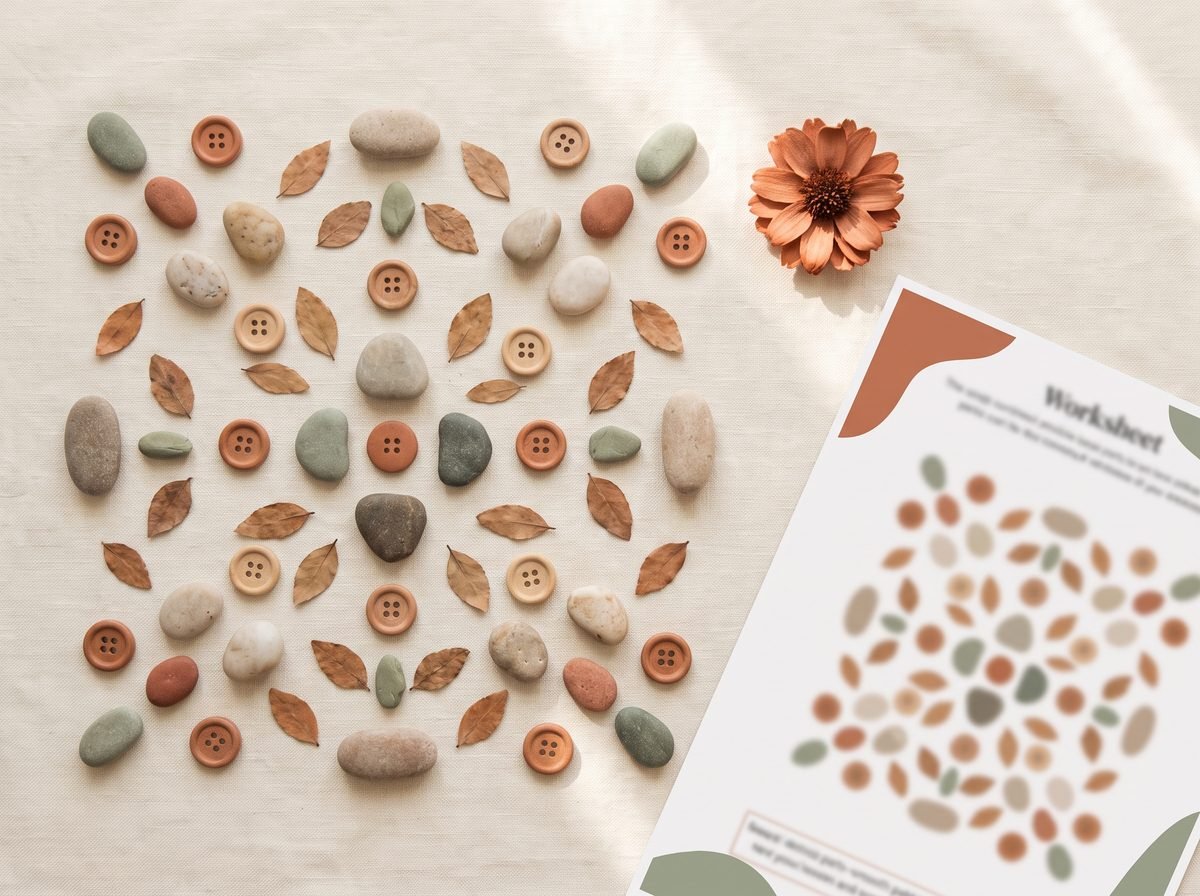
- Nature patterns: Collect leaves, stones, and sticks on a walk and lay them out in a repeat when you get home. With little ones who still mouth things, choose larger pieces and keep an eye out.
For more of this kind of low-prep fun, our collection of easy learning games at home has plenty to fold into an ordinary day.
Gentle next steps once AB patterns click
When AB patterns feel automatic, you’ll know it’s time to nudge forward. Move to ABC, then try ABB, then play with growing patterns. Start inviting your child to describe the rule in words, since naming it is what turns doing a pattern into understanding one. And keep circling back to real objects even after you’ve added printables; the two work best together, not one after the other.
Above all, follow your child’s lead and keep it playful. Patterns are meant to feel like a game, because to a preschooler, the best learning always does.
Hands-On Materials for Patterns
Patterns are easiest to see with objects that differ in only one way, color or shape.
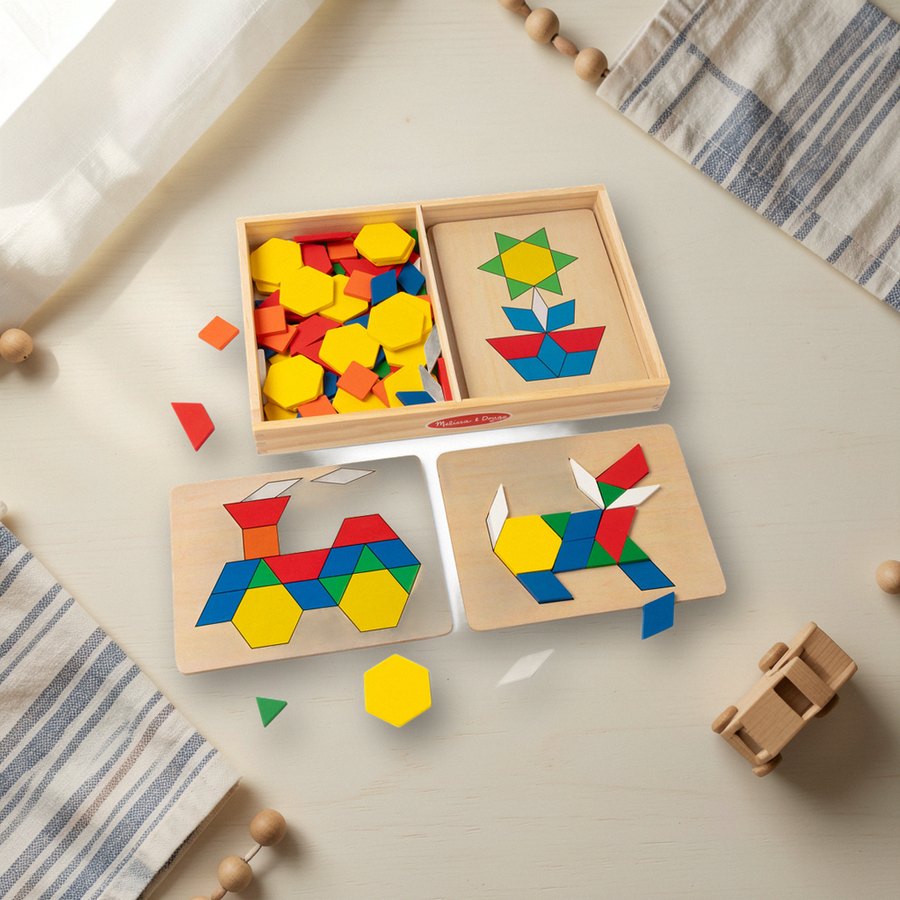 Wooden pattern blocks and boardsView on Amazon
 Linking math cubes, set of 100View on Amazon
 Bear counters, 102 piecesView on Amazon
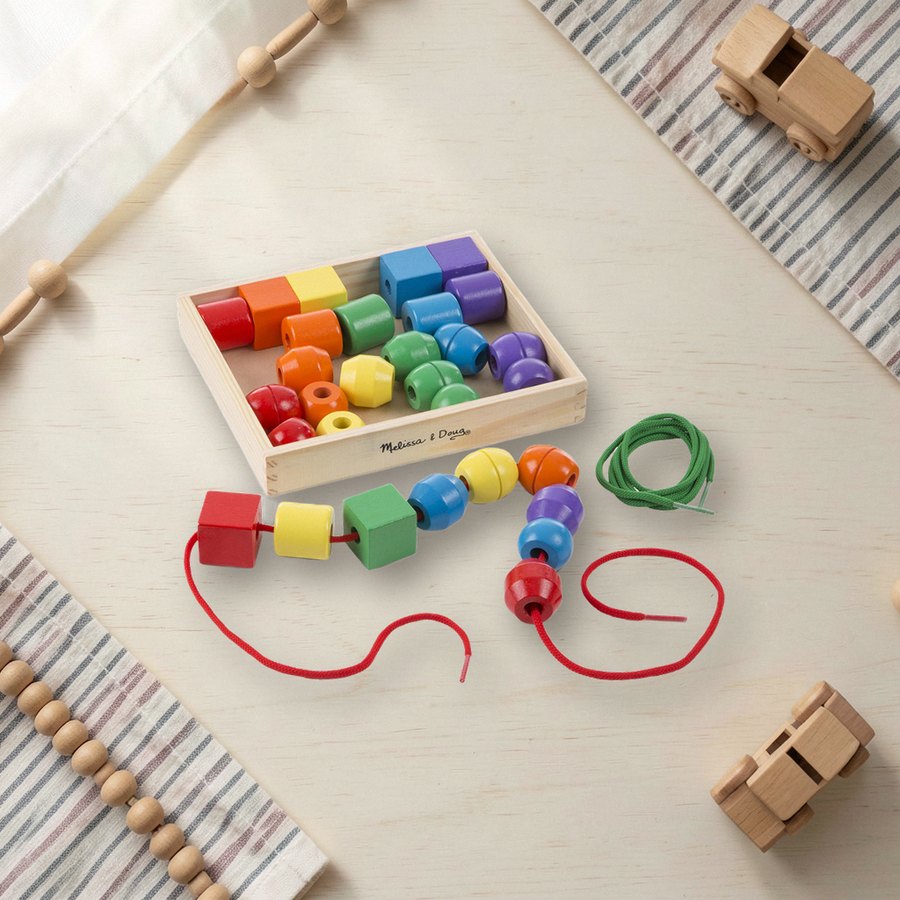 Wooden lacing beads (Melissa & Doug)View on Amazon
As an Amazon Associate, PrintableBloom earns from qualifying purchases.
A calm word to finish
You don’t need a curriculum or a perfect plan to give your child a strong mathematical start. You need a handful of buttons, a few minutes here and there, and a willingness to say “Look, a pattern!” as you move through your day. That’s it. Notice the rhythms already around you, invite your child to join in, and let the counting and the reasoning grow from there, one satisfying red-blue-red-blue at a time.