Best Ways to Teach Numbers to Preschoolers at Home
Here’s a scene most parents know well: you ask your four-year-old to count the apples on the table, and they confidently say “one, two, three, five, eight!” — completely skipping numbers and not noticing at all. They’re not being silly. They’re being a totally normal preschooler whose number sense is still being built, one experience at a time.
Teaching numbers to preschoolers is less about drilling sequences and more about building a real feel for what numbers mean. And the good news? You can do most of it during everyday moments — no fancy curriculum required. If you want a head start with some structured practice at home, our numbers worksheets are a great low-pressure tool to have on hand. But first, let’s talk about how number learning actually works.
What “Knowing Numbers” Actually Means for Preschoolers
When we say a preschooler “knows their numbers,” we usually mean one of several very different things — and understanding the difference helps you teach numbers to preschoolers far more effectively.
Rote Counting vs. Real Counting
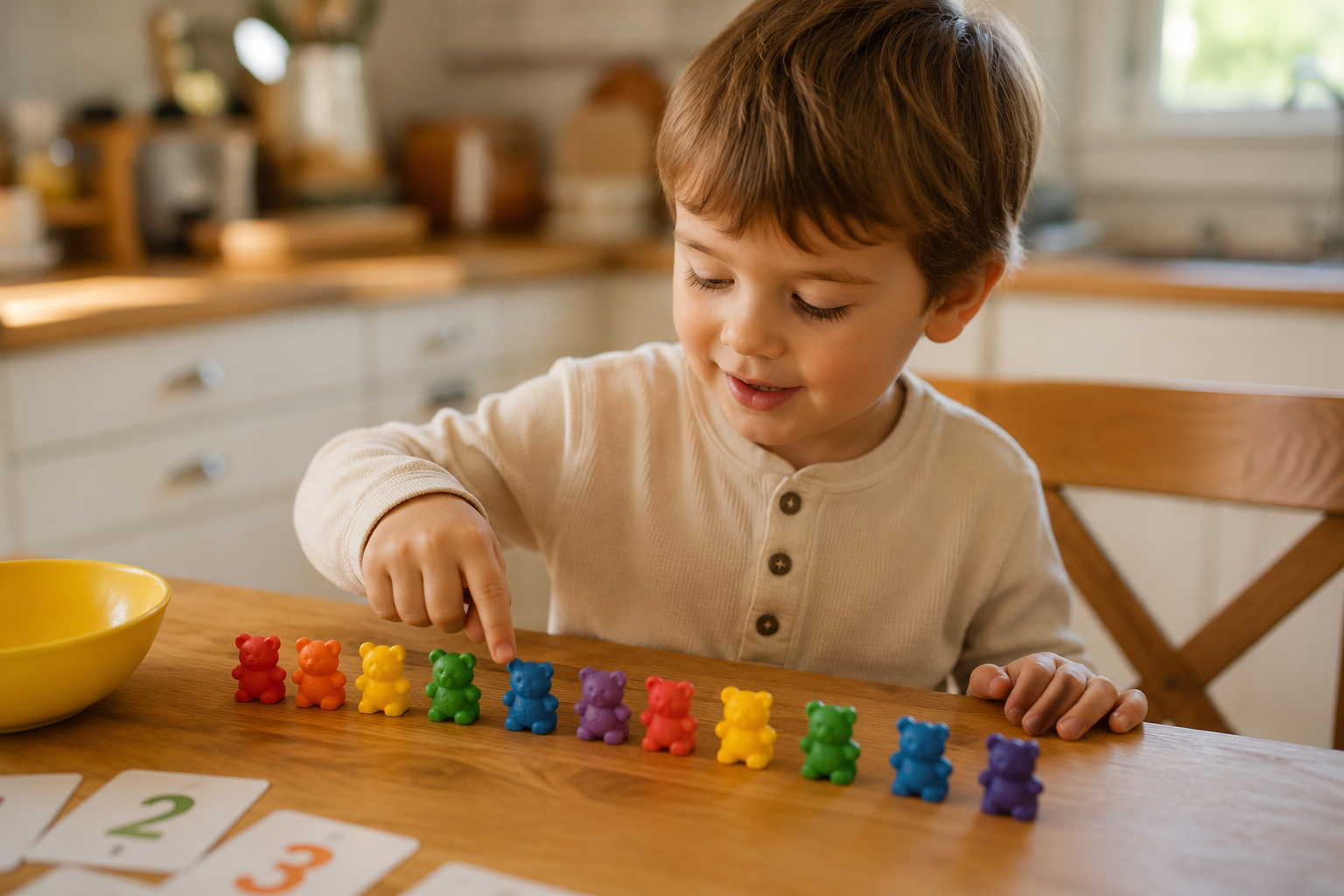
Rote counting is reciting the sequence: “1, 2, 3, 4, 5…” like a song. Most kids can do this before they truly understand what numbers mean. Real counting — called one-to-one correspondence — means pointing to each object as you say a number, understanding that “three” means exactly three things. This is the harder skill, and the more important one for early math readiness.
Number Recognition for Preschoolers
This is seeing the numeral “4” and knowing it’s called “four.” Like letter recognition, this is a visual-symbol skill that develops gradually through exposure and repetition. Number recognition for preschoolers typically builds between ages 3 and 5, usually starting with numbers 1–5 before expanding further.
Number Sense
Number sense is the big-picture understanding that numbers represent real quantities — that five is more than three, that you can split a group of six into two groups of three, that adding one more makes the pile bigger. Child development experts consistently describe number sense as the true foundation for all later math, and it’s built through hands-on experience, not worksheets alone.
Preschool Number Skills by Age: A Simple Overview
Every child develops at their own pace, but here’s a rough guide to what’s typical at each stage — useful for knowing what to focus on right now:
| Age | Typical Number Skill | What Helps Most |
|---|---|---|
| 2–3 | Reciting numbers verbally (“one, two, three…”) | Songs, counting aloud together, number books |
| 3–4 | One-to-one correspondence; counting real objects | Physical objects, counting games, daily routines |
| 4–5 | Number recognition 1–10; understanding more/less | Numeral tracing, preschool math worksheets, quantity games |
| 5–6 | Counting to 20+; simple addition concepts | Number puzzles, structured preschool counting practice |
The Best Ways to Teach Numbers to Preschoolers at Home
You don’t need a classroom or a special curriculum. These preschool number activities fit naturally into the day and are grounded in how young children actually learn.
Count Everything, All the Time
This is the single highest-impact habit you can build. Count stairs as you climb them. Count grapes before you put them on the plate. Count socks while folding laundry. Count steps to the car. When counting is woven into everyday moments, children hear and use numbers dozens of times a day in meaningful contexts — and that repetition builds real number sense faster than any dedicated lesson can.
Use Physical Objects for Preschool Counting Activities
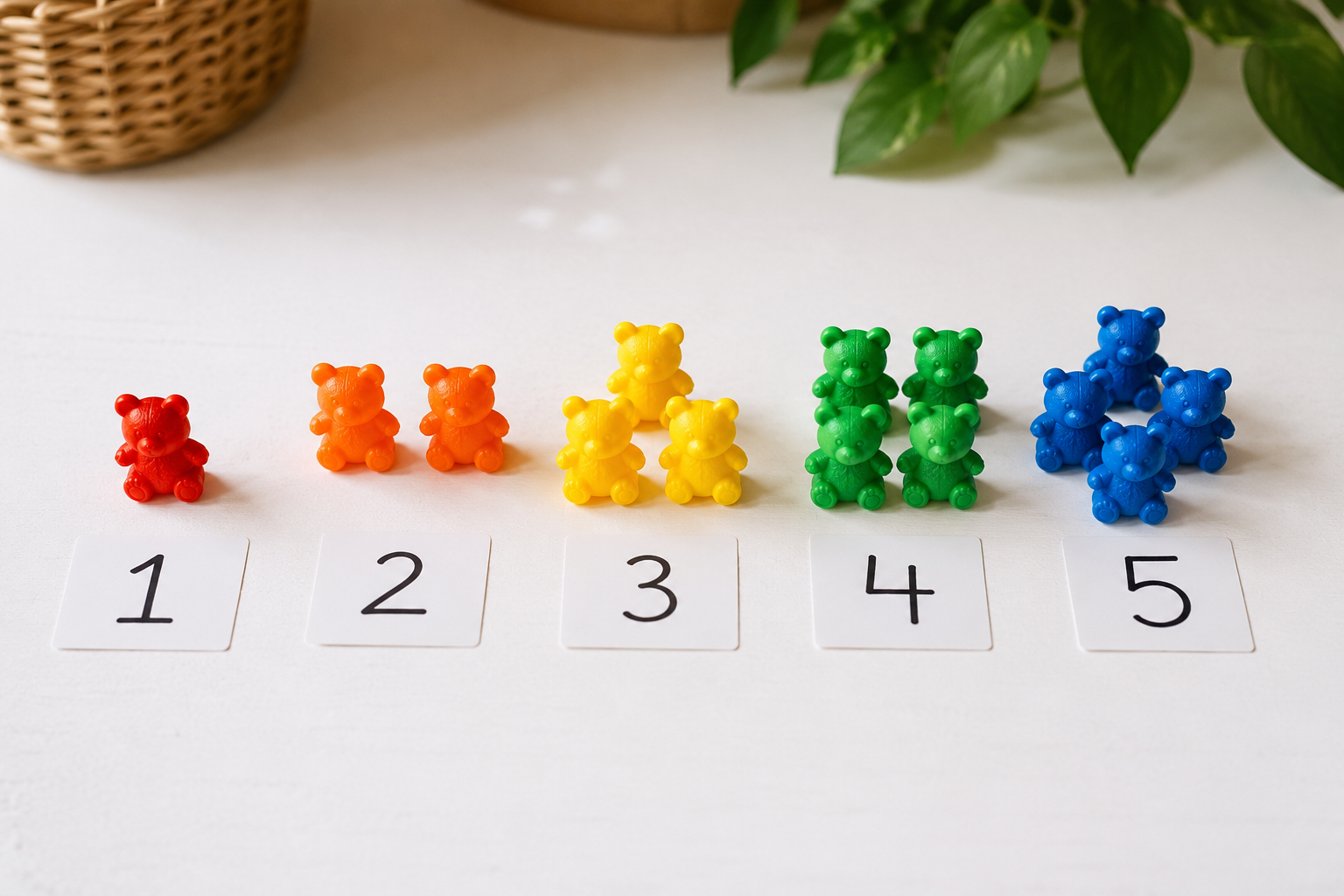
Preschool-age children are concrete thinkers. They need to touch and move things to build number understanding. Blocks, buttons, small toys, pasta shapes — anything that can be sorted and counted works. When a child physically moves an object as they say a number, they’re building one-to-one correspondence in a way that is deeply memorable. These hands-on counting activities for preschoolers cost nothing and take minutes to set up.
Give your child a pile of small objects (beans, buttons, coins). Ask them to move each one to a separate spot as they say its number — left pile to right pile, one at a time. This simple physical action dramatically improves counting accuracy in preschoolers and is one of the most recommended number sense activities by early educators.
Play Simple Counting Games for Preschoolers During Daily Routines
Bath time, snack time, car rides, and grocery trips are all opportunities for preschool math activities that feel nothing like school. “Can you put three toy fish in the water?” “Grab four crackers from the bowl.” “How many red cars can you count?” These small moments require no setup, no materials, and almost no extra time — but they add up to hours of meaningful number practice every week.
Read Number Books Together
There are dozens of wonderful picture books built around counting and number recognition. Books like Ten Black Dots, Chicka Chicka 1 2 3, or The Very Hungry Caterpillar weave numbers into engaging stories. Point to the numerals, count the objects on the page, and let your child touch the pictures. Reading is one of the most natural ways to build number recognition for preschoolers — and it doubles as bonding time.
Introduce Preschool Math Worksheets at the Right Time
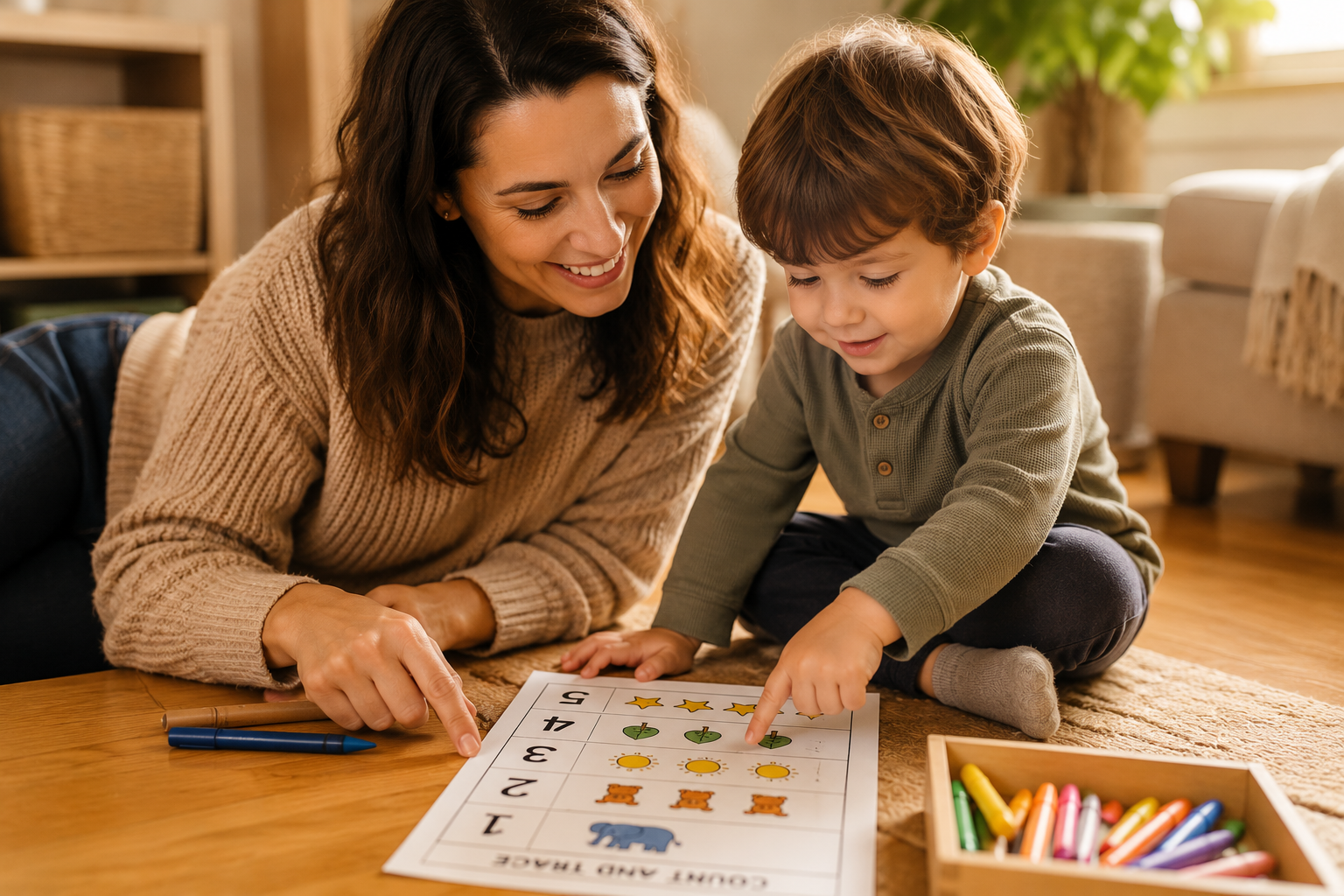
Once a child has some foundation — usually around age 3.5 to 4 — simple printable activities add a valuable layer of structured preschool counting practice. Tracing numerals builds the visual-motor connection. Counting-and-circling activities strengthen one-to-one correspondence. Matching numbers to quantities bridges the gap between symbol and meaning.
Our math worksheets for preschool cover all of these skills in a calm, focused format that works well for short daily sessions. And our broader math worksheets collection has options for every level from toddler through early elementary.
Common Mistakes That Slow Down Learning Numbers at Home
Focusing Only on Rote Counting
If your main strategy is practicing the counting sequence — “1, 2, 3, 4, 5…” over and over — you’re building one layer of number knowledge while skipping the others. Balance rote practice with real preschool counting activities using physical objects and conversations about quantity (“which pile has more?”).
Moving to Worksheets Too Early
A two-year-old isn’t ready for number tracing worksheets, and that’s perfectly fine. Introducing structured activities before a child has the developmental readiness creates frustration and negative associations with math — exactly the opposite of what you want. Follow your child’s lead. If they’re engaged and enjoying it, great. If they’re shutting down, back off and return to hands-on play.
Skipping the “How Many?” Question
Children can learn to recite numbers without ever developing true cardinality — the understanding that the last number you say tells you “how many” are in the group. Early childhood educators emphasize asking “how many?” after every counting moment rather than stopping at the count itself. “One, two, three, four… so how many cars is that?” — that final question is where real number understanding gets built.
A Simple Weekly Routine for Learning Numbers at Home
You don’t need to do everything at once. Here’s a low-effort weekly rhythm that builds real number skills over time without turning your home into a classroom:
- Count something at every meal (grapes, crackers, spoonfuls)
- Read one number-themed picture book this week
- Do one 10-minute printable activity (numeral tracing or counting page)
- Play one counting game during bath time or a car ride
- Ask “how many?” after every counting moment — make it a reflex
- Point out numerals in the environment: clocks, doors, food packaging
When Preschool Math Activities Feel Like a Struggle
Some preschoolers take to numbers easily. Others need more time, more repetition, or a completely different approach. If your child resists number activities, try these adjustments before worrying:
- Switch the context. If table-time practice isn’t working, try counting during outdoor play or in the bath.
- Use their interests. A child obsessed with dinosaurs will engage with counting dinosaur toys far more willingly than abstract counters.
- Make it a gentle competition. “Let’s both grab some blocks — who has more? Let’s count and find out!”
- Shorter and more often. Three minutes of counting at three different moments beats one ten-minute “math session” every time.
Materials for Number Practice
Numbers make sense faster when a child can count real objects and then write the numeral.
 Bear counters, 102 piecesView on Amazon
 Linking math cubes, set of 100View on Amazon
 Magnetic letters and numbersView on Amazon
 9 x 12 dry erase lapboards, 2 packView on Amazon
As an Amazon Associate, PrintableBloom earns from qualifying purchases.
Conclusion
The best way to teach numbers to preschoolers isn’t a specific app or a perfectly structured lesson — it’s showing up, again and again, in the small everyday moments that don’t feel like teaching at all.
Count the grapes. Ask “how many?” Count the steps to the car. Hand them a pile of buttons and a number card. Print out a simple worksheet for a quiet afternoon. None of it is complicated. All of it matters.
The number sense you’re building right now — patiently, playfully, one counted cracker at a time — is the same foundation your child will stand on in kindergarten, first grade, and well beyond. You don’t have to do it perfectly. You just have to keep doing it. And they’ll get there.
Frequently Asked Questions
At what age should a preschooler know their numbers?
By age 3, most children can recite numbers to 5 or 10 in sequence, though they may not yet match them to real quantities. By age 4–5, counting reliably with one-to-one correspondence up to 10, recognizing numerals 1–10, and understanding basic quantity concepts like more and less is a reasonable expectation — though development varies widely between children.
What’s the difference between counting and number sense?
Counting is the ability to recite the number sequence and match numbers to objects. Number sense is the broader understanding of what numbers mean — how quantities relate to each other, how numbers can be combined and split, and why “five” always means exactly five things. Number sense is the deeper skill, and it develops through hands-on number sense activities, not rote practice alone.
How long should preschool counting practice sessions be?
Keep sessions short — 5 to 10 minutes for ages 3–4, up to 15 minutes for older preschoolers who are engaged. The goal is to end while they’re still interested, not to push until they resist. Multiple short moments throughout the day are far more effective than one long math session.
Are preschool math worksheets appropriate for young children?
Yes, when used appropriately. Number tracing, counting activities, and numeral recognition pages are genuinely useful for children aged 3.5 and older — provided sessions are short, the activities match the child’s readiness, and there’s no pressure around getting things right. Preschool math worksheets work best as one piece of a broader routine that includes lots of hands-on play and real-world counting.
My child can count to 20 but doesn’t understand what numbers mean. Is that normal?
Completely normal, especially under age 4. Rote counting develops earlier than true cardinality. Keep providing hands-on counting activities for preschoolers with real objects, and that deeper understanding will follow. If a child is over 5 and still struggles significantly with one-to-one correspondence, it’s worth mentioning to your pediatrician.
What number skills matter most for kindergarten readiness?
Child development experts highlight these as the key number skills before kindergarten: reliable counting to 20, one-to-one correspondence with physical objects, recognizing numerals 1–10, understanding “more than” and “less than,” and beginning to grasp that numbers can be added together. Strong foundations in these areas give children a genuinely confident start in kindergarten math.
Related reading
- How Preschoolers Actually Learn the Alphabet
- Homeschool Learning Ideas for Preschoolers That Actually Work
- Early Reading Skills Every Preschooler Needs
- What to Do If Your Child Hates Worksheets