
What to Do If Your Child Hates Worksheets
You print out a nice simple worksheet, you sit your child down with a hopeful smile, and within thirty seconds it’s a standoff. Maybe there are tears. Maybe there’s a flat “no.” Maybe they scribble across the whole page just to make their feelings clear. If your child hates worksheets, you are in extremely good company — this is one of the most common frustrations parents of preschoolers face.
Here’s the reassuring part: worksheet resistance almost never means your child can’t learn or won’t learn. It usually means the worksheet, in that moment, isn’t the right tool. The good news is that every skill a worksheet builds can also be built through play — and once you understand why the resistance is happening, the fix is usually simpler than you’d expect. If you do want worksheets that feel more like play than work, our coloring pages are a gentle entry point. But first — let’s understand what’s really going on.
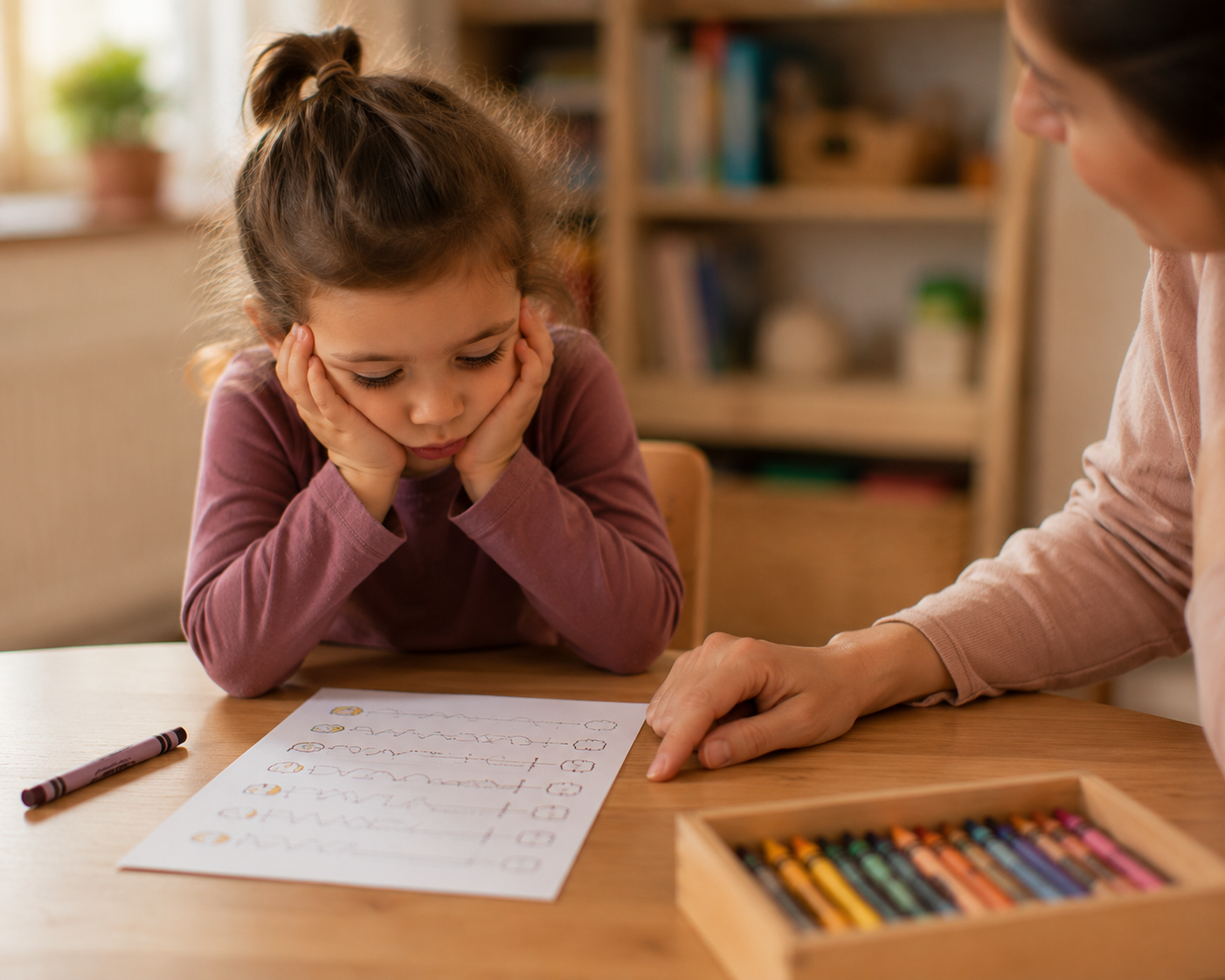
Why Your Child Hates Worksheets (The Real Reasons)
Worksheet refusal is rarely about laziness or defiance. There’s almost always an underlying reason — and identifying it points directly to the solution.
The Worksheet Is Too Hard (or Too Easy)
This is the most common cause. A worksheet pitched above a child’s current skill level produces frustration; one pitched below it produces boredom. Both lead to refusal. Child development experts call this the importance of the “just right challenge” — activities slightly above current ability but still achievable. When a worksheet is in that zone, engagement comes naturally. When it’s not, resistance is the predictable result.
They’re Not Developmentally Ready for Seated Work
Some preschoolers — especially younger ones and those with high movement needs — simply aren’t ready to sit and focus on a static page yet. This isn’t a problem to fix; it’s a stage to work around. Forcing seated work before a child is developmentally ready creates negative associations that can last far longer than the developmental gap itself.
It Feels Like Pressure
Children are remarkably sensitive to the emotional weight adults attach to activities. If worksheets come with an undertone of “you need to do this” or “let’s see if you can get it right,” many children push back — not against the task, but against the pressure. The same skill offered through relaxed play feels completely different.
Worksheets Feel Disconnected From Play
For a preschooler, the natural mode of learning is play — active, hands-on, imaginative, self-directed. A worksheet asks them to sit still and produce something specific on demand, which is the opposite of how they’re wired to learn at this age. The resistance is often just their developing brain saying “this isn’t how I learn best.”
The Skills Worksheets Build — and How to Build Them Through Play
Here’s the liberating truth: there is no skill that can only be built through worksheets. Every single one has a play-based equivalent that’s often more effective for a child who resists seated work.
| Worksheet Skill | Play-Based Alternative |
|---|---|
| Letter tracing | Form letters with playdough, write in sand/salt trays, chalk on pavement |
| Number recognition | Count toys, sort objects by number, number scavenger hunts |
| Fine motor / pencil control | Threading beads, tongs games, playdough, cutting practice |
| Matching & sorting | Sort laundry by color, match socks, group toys by type |
| Shape recognition | Shape hunts around the house, building with blocks, cookie cutters |
| Coloring within lines | Painting, stickers on targets, chalk drawing, sensory bin “painting” |
Gentle Strategies to Reduce Worksheet Resistance
If you’d still like worksheets to be part of the picture — and they can be valuable when they work — here’s how to reduce the resistance without turning it into a battle.
Lower the Stakes Completely
Remove every trace of pressure. No “let’s see if you can,” no corrections, no expectations about finishing. Put a worksheet out alongside crayons as just one option among several, and let your child choose whether to engage. Paradoxically, the less you need them to do it, the more likely they are to try.
Make It Hands-On
Turn the worksheet into a physical activity. Use stickers instead of a crayon to mark answers. Use a bingo dauber to dot letters. Let them use a special “magic pen.” Add a tactile element — a worksheet a child can touch and manipulate feels less like seated work and more like play.
Never present a worksheet as the only option. Instead, offer a choice: “Do you want to do the dinosaur counting page or play the counting game with your blocks?” When children feel they have control over how they learn, resistance drops dramatically. Both options build the same skill — the choice just gives them ownership, which is developmentally crucial for this age.
Follow Their Interests
A child who refuses a generic counting worksheet may eagerly do one featuring their favorite theme. Dinosaurs, trucks, princesses, space, animals — matching worksheets to a child’s current obsession transforms a chore into something they actually want to do. Interest is the single most powerful motivator at this age.
Keep It Extremely Short
If your child hates worksheets, start with a ridiculously small amount — one line of tracing, two items to circle. Ending while it’s still easy and positive builds the willingness to try again. Many parents find that a child who refused a full page will happily do “just this one little part” — and over time, that willingness grows.
Do It Alongside Them
Sit down with your own paper and do the activity too. Color your own page. Trace your own letters. Children are powerfully drawn to doing what their parents are doing. Turning it into a shared, side-by-side activity rather than a task you’re assigning often dissolves resistance on its own.
When to Step Back Entirely
Sometimes the right answer is simply: not yet. If worksheets consistently produce tears, meltdowns, or genuine distress despite all these adjustments, it’s a clear signal to step back from them entirely for a while. There is no developmental requirement that a preschooler do worksheets. None.
Build the skills through play for a few months. Come back to worksheets later — when your child is older, more developmentally ready, and starting fresh without the negative associations. Many children who hated worksheets at 3.5 take to them easily at 4.5, simply because they’re ready and the slate is clean.

Reframing What “Learning” Looks Like
Part of what makes worksheet resistance so stressful for parents is a deep, often unspoken belief that worksheets equal learning — that a stack of completed pages is proof a child is making progress. But early childhood educators consistently push back on this idea. A child who sorts buttons by color, counts the steps to the mailbox, builds an elaborate block tower, and asks a hundred questions a day is learning intensely — far more than a reluctant child slogging through a worksheet they hate.
The worksheets were never the point. The skills were the point. And skills can be built a hundred different ways — many of which look nothing like school, and most of which a worksheet-averse child will embrace willingly.

A Gentle Plan for Worksheet-Resistant Kids
- Identify the real reason: too hard? not ready? feels like pressure?
- Switch to play-based alternatives for the same skills
- If using worksheets, offer them as a choice, never a demand
- Make worksheets hands-on: stickers, daubers, special pens
- Match worksheets to your child’s current interests
- Keep any worksheet session ridiculously short — one line counts
- If resistance is intense, take a full break and revisit later
Conclusion
If your child hates worksheets, you haven’t failed and neither have they. You’ve simply discovered that this particular tool isn’t the right fit right now — and that discovery is genuinely useful, because it frees you to teach the same skills in ways that actually work for your child.
Some of the most curious, capable, brilliant kids resist worksheets fiercely at this age. They’re not behind. They’re just wired for a different kind of learning — the hands-on, active, play-based kind that preschoolers are designed for in the first place.
Follow their lead. Build skills through play. Drop the pressure. And trust that the child sorting buttons on your kitchen floor right now is learning everything they need to — worksheet or no worksheet. Because they are.
Frequently Asked Questions
Is it normal for preschoolers to hate worksheets?
Extremely normal. Many preschoolers — especially younger ones and those with high movement needs — resist worksheets because seated, structured work runs counter to how they naturally learn at this age. Worksheet resistance is almost never a sign of a learning problem. It’s usually a sign that the format, difficulty, or amount of pressure isn’t matched to where the child is developmentally.
Should I force my child to do worksheets?
No. Forcing worksheets typically backfires — it creates negative associations with learning that can last far longer than any skill gap. There’s no developmental requirement that preschoolers complete worksheets. The skills worksheets build can all be developed through play, which is often more effective for a resistant child. Gentle invitation and choice work far better than force at this age.
How can I teach letters and numbers without worksheets?
Letters can be taught through playdough letter-forming, sand/salt tray writing, chalk drawing, letter hunts, and daily read-alouds. Numbers can be taught through counting real objects, sorting games, number scavenger hunts, and embedding counting in daily routines. These hands-on, play-based approaches build the same skills — often more effectively for children who resist seated work.
My child loved worksheets before but now refuses them. What changed?
Several things could explain this. The worksheets may have become too easy (boredom) or suddenly too hard (frustration). Pressure may have crept into the activity. Or your child may simply be going through a developmental phase of asserting independence — refusing things they previously accepted is a normal part of preschool development. Lowering the stakes, offering choice, and adjusting the difficulty usually helps. If not, a short break often resets things.
At what age should worksheets become part of learning?
There’s no required age. Simple, low-pressure worksheets can be introduced around age 3 to 3.5 for children who show interest, but many children aren’t ready for or interested in worksheets until age 4 or later — and that’s completely fine. Worksheets are one optional tool among many, not a developmental milestone. Following readiness and interest matters far more than starting at a particular age.
Will my child be behind if we skip worksheets in preschool?
No. Children who learn through play-based methods consistently arrive at kindergarten equally prepared — and often with stronger motivation to learn and better social-emotional skills. The foundational skills that matter (letter recognition, number sense, fine motor control, language) can all be built through play, reading, and everyday activities. Worksheets are a convenient tool, not a necessity. Skipping them entirely in favor of rich play-based learning is a completely valid approach.
Related reading
- Printable Activities That Actually Keep Kids Focused
- Easy Learning Games for Preschoolers at Home
- Homeschool Learning Ideas for Preschoolers That Actually Work
- Why Tracing Activities for Preschoolers Matter Before Writing