Supporting Focus at Home: Gentle Routines for Kids Who Get Distracted Easily
You set out the crayons, your four-year-old sits down, and within ninety seconds she’s under the table pretending to be a cat. Sound familiar? If you’ve ever wondered whether your child is the only one who can’t seem to stay with one thing, I want to gently reassure you: this is one of the most normal, most universal parts of early childhood. Short attention spans aren’t a problem to fix so much as a stage to work with.
I’ve spent years in early-childhood classrooms and I’m a mom myself, so I’ve watched this play out with dozens of little ones and my own kids at the kitchen table. The good news is that a few small changes to the environment and the way we structure activities can make a real difference for high-energy, easily distracted children. Nothing clinical here, just calm, practical ideas you can try this week.
Why young kids get distracted (normal attention spans by age)
Before we change a single thing, it helps to reset our expectations. Young children simply aren’t built for long stretches of focus, and the numbers might surprise you. One loose rule of thumb that gets passed around parenting and teaching circles is that a child can concentrate for roughly two to five minutes per year of age. It’s a ballpark, not a stopwatch, but it’s a useful reminder of just how short these windows really are. In everyday practice, most little ones land toward the lower end of that range:
- A 2-year-old: often just a handful of minutes, maybe 4 to 6, on something they picked.
- A 3-year-old: around 6 to 9 minutes on a good day.
- A 4-year-old: commonly 8 to 12 minutes.
- A 5- to 7-year-old: often 10 to 20 minutes, and even that comes in waves.
Treat those figures as gentle guideposts rather than targets to hit. And here’s the part worth underlining: those windows shrink even further when the activity is something we chose rather than something they’re excited about. A preschooler who can build with blocks for twenty happy minutes may last barely three on a worksheet. That’s not defiance or a lack of ability. It’s a brain that’s still growing the very circuits responsible for sustained attention, impulse control, and filtering out distractions.
When you know that a five-minute stretch is a genuine win for a four-year-old, you stop feeling like something’s going wrong, and you start setting up activities that fit the child in front of you.
Set the environment up for focus (less is more)
The single most powerful lever you have isn’t a new technique. It’s the room. Little ones haven’t yet developed the ability to tune out competing sights and sounds, so a busy space quietly pulls their attention in ten directions at once. Our job is to remove the competition.
A few things that consistently help:
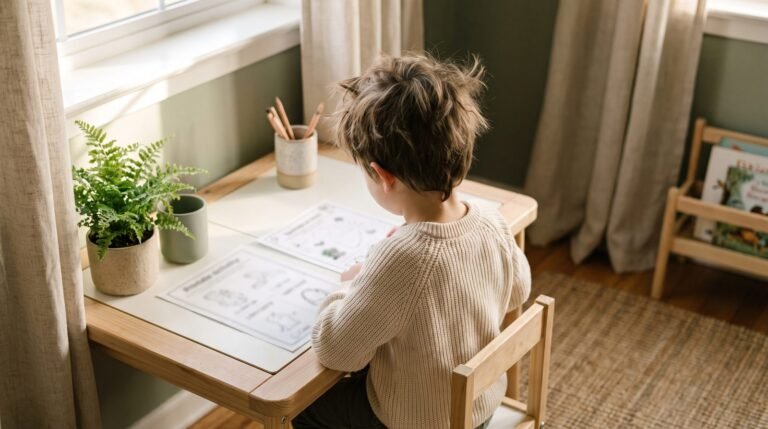
- Clear the surface. One activity on the table, everything else put away. A tabletop covered in markers, toys, and yesterday’s crafts is a menu of distractions. Offer the one thing you want them to focus on and nothing more.
- Turn down the background. A TV murmuring in the next room, music with lyrics, or a busy window view all compete for a young child’s attention. Aim for a calm, quiet-ish corner, even if it’s just one end of the sofa.
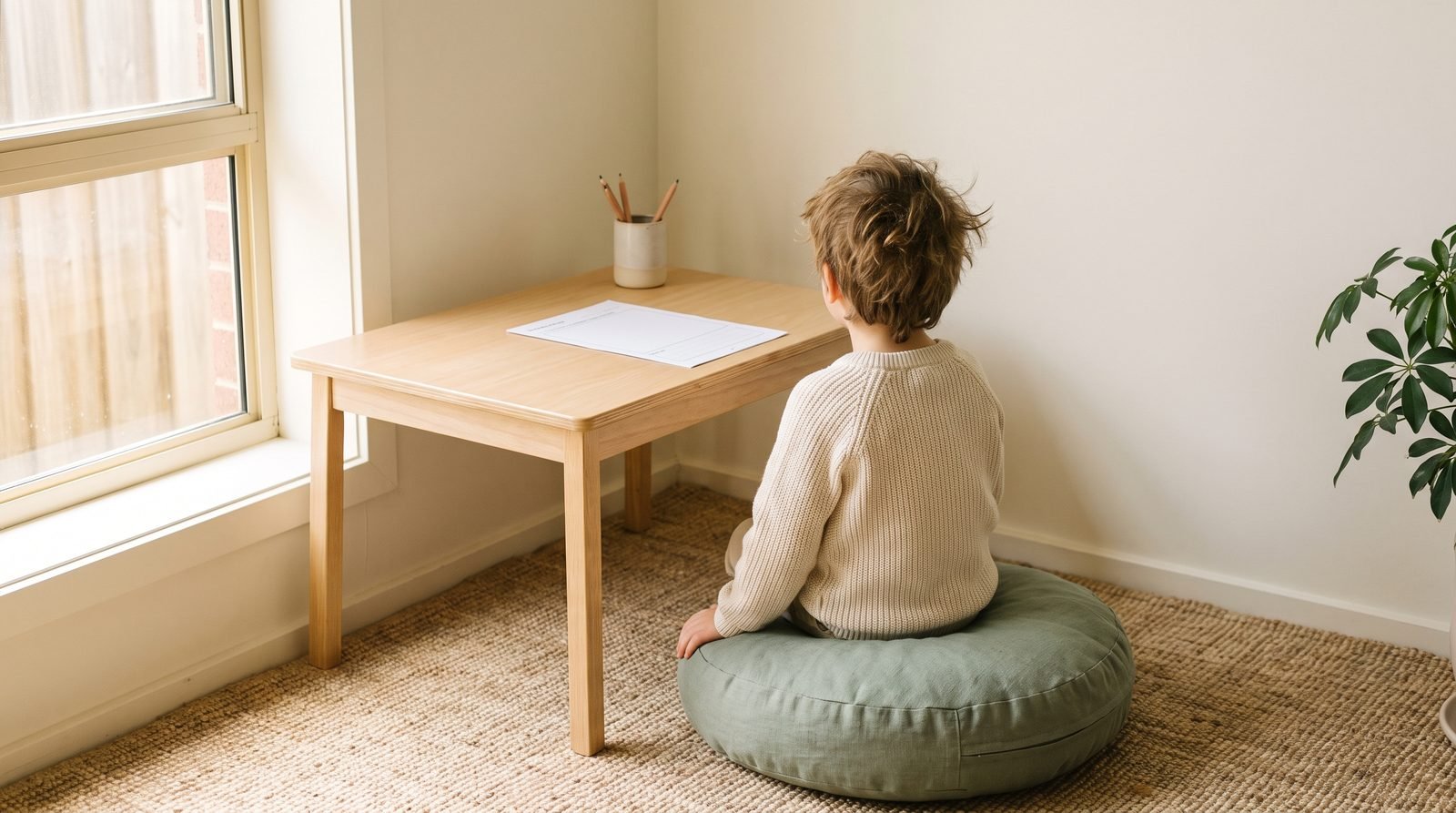
- Face a plain wall, not the room. Seating a child so they look at a blank wall rather than the toy shelf or the doorway removes a surprising amount of visual pull.
- Keep it cozy, not clinical. This isn’t about a bare, sterile space. Soft light, a comfortable cushion, and warm tones help a child feel settled. Calm and inviting, just uncluttered.
If you want to go a step further, a small, consistent focus corner can work wonders. A defined mat or a simple tray helps mark out “this is where we do our thinking work,” which cues the brain before you’ve said a word.
Short sessions and built-in movement breaks
Once the space is calmer, the next shift is time. If a four-year-old’s focus window is around eight to twelve minutes, then a twenty-five-minute activity is guaranteed to end in wiggles and frustration for both of you. So we plan for short and sweet.
Think in small blocks. Five to ten minutes of an activity, then a deliberate break, then perhaps a second short block if your child is still game. You are not aiming for one long sitting; you’re aiming for a couple of good short ones. Two focused five-minute rounds beat one miserable fifteen-minute standoff every time. If you’d like a fuller breakdown by age, I wrote more about how long learning sessions should be that pairs nicely with this.
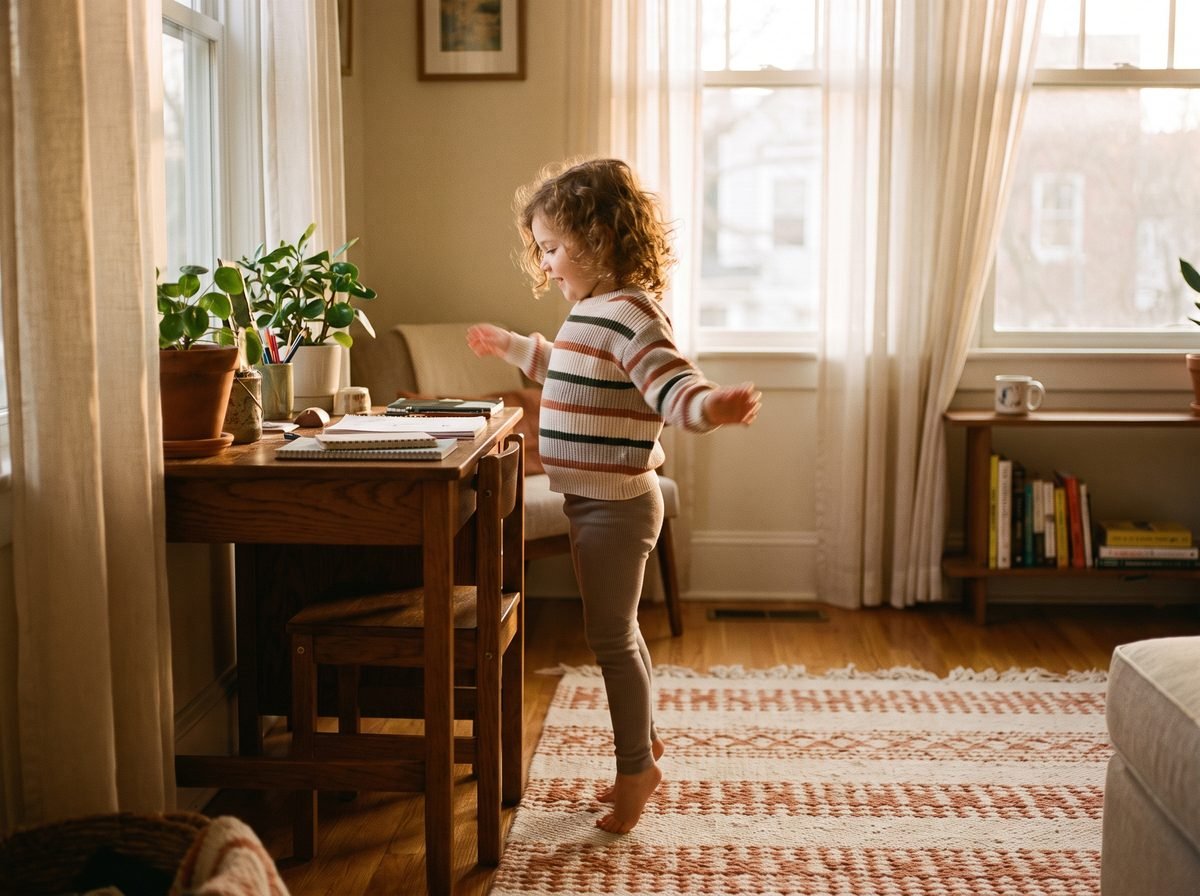
The break matters as much as the work, especially for active kids. Movement isn’t the enemy of focus; for many children, it’s the reset button. Instead of asking a body that needs to move to sit still longer, give it a job:
- Ten jumping jacks or “pop like popcorn” between tasks.
- A quick lap of the living room or a march to the kitchen and back.
- Animal moves: hop like a frog, stomp like an elephant, tiptoe like a mouse.
- A big stretch up to the ceiling and down to touch toes.
Sixty seconds of real movement often buys you another few minutes of genuine attention. For kids who are especially fidgety, letting them stand at the table, wobble on a cushion, or squeeze a soft toy while they work can channel the extra energy instead of fighting it.
One task at a time: reducing overwhelm
Distraction and overwhelm often look identical from the outside. A child who’s been handed too much at once will frequently do the very thing that looks like not paying attention: bounce away, go quiet, or start doing something else entirely. The fix is to make the task feel small.
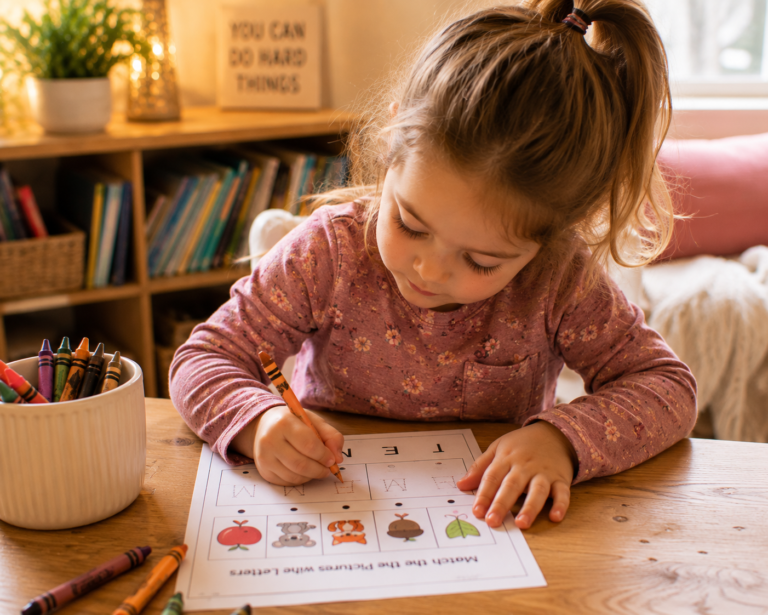
Break things down further than feels necessary. Rather than “let’s do this whole worksheet,” try “let’s just color this one apple.” When that’s done, celebrate it, then offer the next single step. A big page of ten items can read as impossible to a young child; the same page tackled one item at a time feels doable.
A few phrases that help keep it to one thing:
- “First we’ll do this one, then we’ll see.”
- “Just this part. That’s all we need right now.”
- “You finished that one. Want to pick the next?”
Giving a little bit of choice (“the red one or the blue one first?”) also lifts engagement, because a task a child feels some ownership of holds their attention far longer than one that’s simply assigned. And do resist the urge to stack instructions. “Get your pencil, sit down, open to the page, and start” is four commands a preschooler will lose halfway through. One clear step at a time is kinder and far more effective.
Using routines and visual cues to anchor attention
Children who get distracted easily are often the same children who thrive most on predictability. When a child knows what’s coming, their brain doesn’t have to spend energy wondering or resisting, and more of that energy is free for the task itself. Routine is quietly one of the best focus tools there is.
You don’t need a rigid schedule. A gentle, repeating rhythm is enough: we do a little activity after breakfast, or coloring always happens before bath time. Doing the focused work at the same point in the day, when your child is rested and fed rather than hungry or overtired, stacks the odds in your favor before you begin.
Visual cues make routines even easier for little ones who can’t yet read a clock or a list. A simple picture chart showing the steps of the morning, or a small “first this, then that” card, gives a child something concrete to follow and a satisfying sense of progress as they move through it. A predictable picture sequence lets the chart do the reminding, so you don’t have to nag, and the child gets to feel the quiet pride of moving through it on their own.
A few visual anchors that work well:
- A picture sequence of the activity’s steps, so the child can see the finish line.
- A simple timer they can watch, framed as “let’s see how far we get before the sand runs out” rather than a pressure countdown.
- A consistent spot that means “focus time,” so sitting there itself becomes a cue.
Sensory needs that can look like distraction
Here’s something that took me a while to fully appreciate in the classroom: a lot of what reads as “not focusing” is actually a child trying to meet a sensory need. The little one who keeps getting up may need more movement. The child who fiddles with everything may be seeking something to do with their hands. The one who covers their ears or melts down in a busy room may be overwhelmed by noise, not being difficult.
When you start seeing wiggling and fiddling as information rather than misbehavior, whole new solutions open up. A child who needs to move can be given a wobble cushion or allowed to stand. A child whose hands are busy can hold a small fidget or a smooth stone while they listen. A child who’s overwhelmed by a loud, bright space will focus far better in a calmer, dimmer corner. You’re not lowering your expectations; you’re removing an obstacle you couldn’t see before.
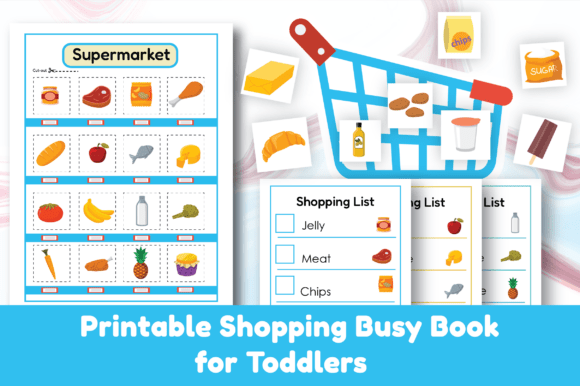
The pattern is simple: watch what your child does when they’re distracted, and ask what need that behavior might be meeting. Then try to meet it in a way that fits the activity. This is where a bit of trial and error pays off, and where those printable activities that keep kids focused can help, because a well-chosen, hands-on task often satisfies several sensory needs at once.
A note on when to check in with your pediatrician
Everything in this article is about typical, run-of-the-mill early-childhood attention, and the vast majority of easily distracted little ones are simply being their age. That said, you know your child best. If distraction seems dramatically beyond what you see in other children the same age, if it’s causing real distress at home, at preschool, or with friends, or if you simply have a nagging worry you can’t shake, it’s absolutely worth mentioning to your pediatrician. There’s no diagnosing to be done at the kitchen table, and I’m not here to raise alarms. A pediatrician can listen, reassure you, and help you figure out next steps if any are needed. Trusting your gut and asking a professional is always a reasonable, caring thing to do.
Gentle wins to build on
If you try just one thing from this list, let it be the environment: clear the table and quiet the room, and you’ll likely see a difference the same day. From there, layer in short sessions with real movement breaks, one small step at a time, and a predictable rhythm your child can lean on. These aren’t dramatic overhauls; they’re small, repeatable adjustments that add up.
Most of all, go easy on yourself and on your child. A wiggly, curious, easily distracted preschooler is not a project to be corrected. Some of the most enthusiastic, joyful children I’ve taught were also the hardest to keep in a chair, and that energy is a wonderful thing to grow up with. Celebrate the two-minute stretches, notice the small progress, and let the focus come as it will. It grows a little more every year, and you’re doing better than you think.
Tools That Support Focus
These do not fix attention. They remove some of what works against it: an unclear end time, a still chair and background noise.
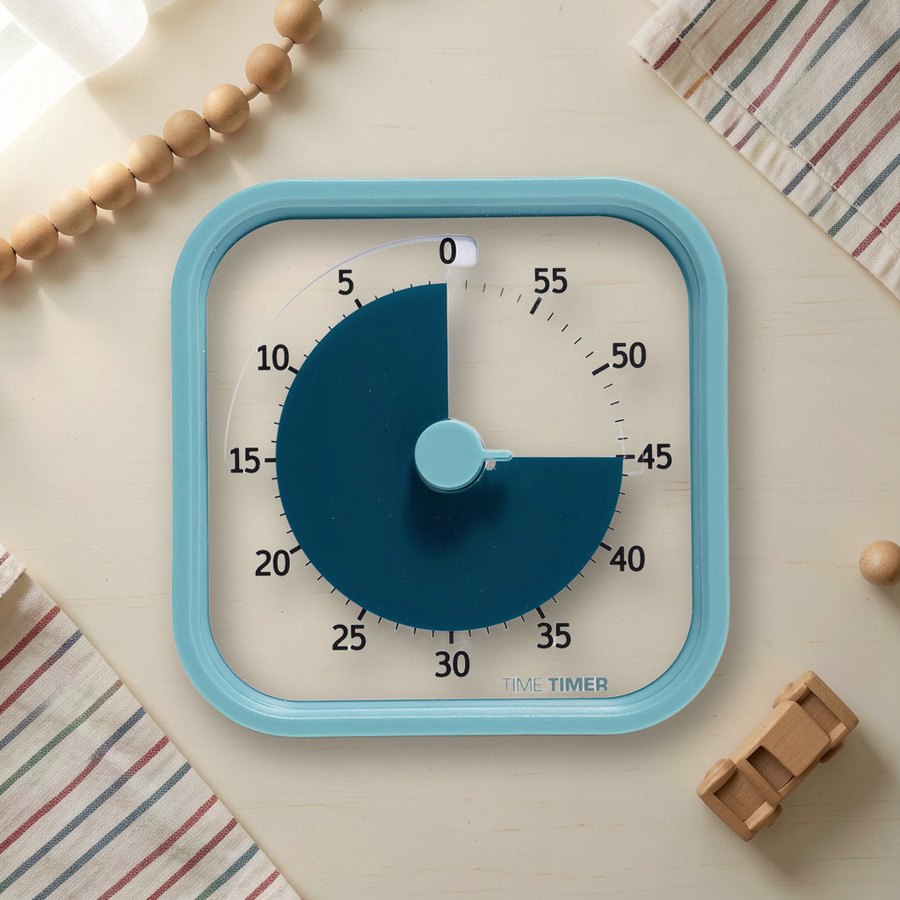 60-minute visual timer (Time Timer)View on Amazon
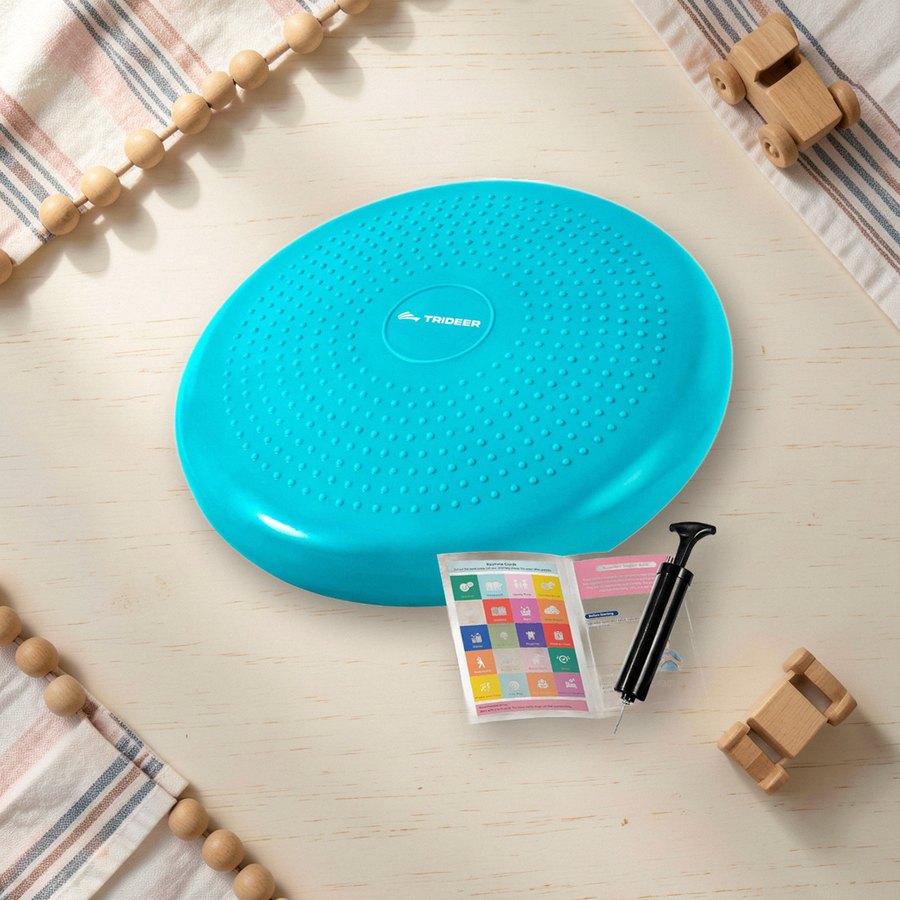 Wobble cushion seatView on Amazon
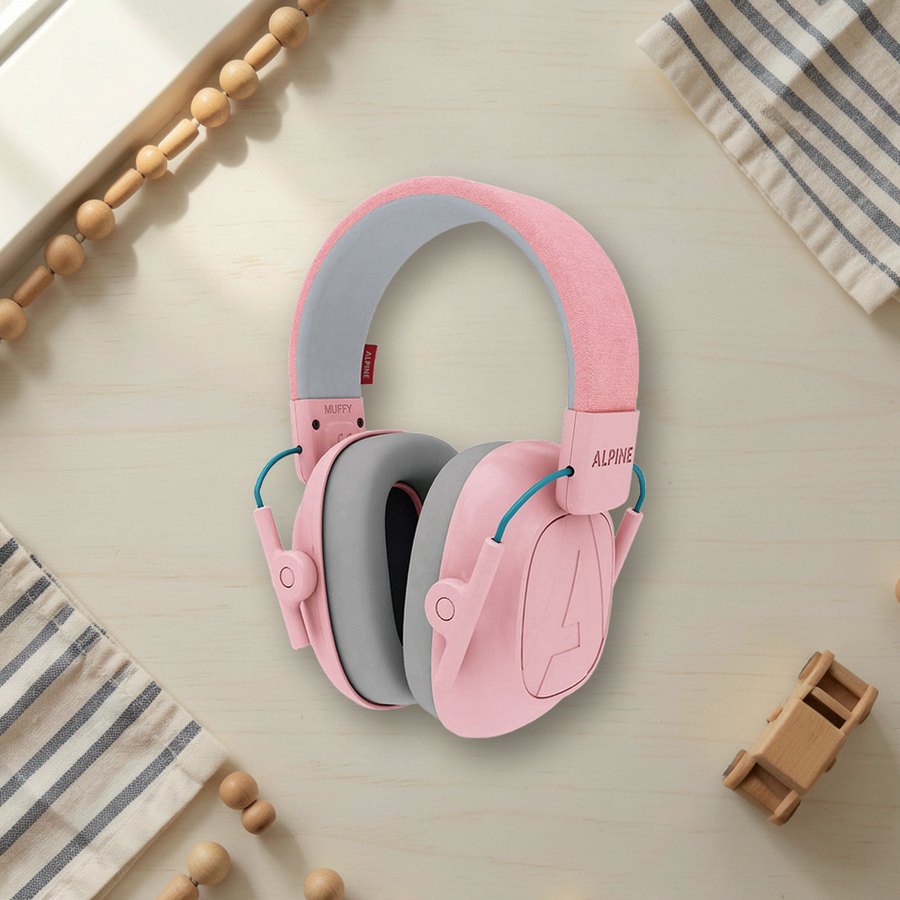 Kids noise-reducing ear muffsView on Amazon
As an Amazon Associate, PrintableBloom earns from qualifying purchases.