Fun Screen-Free Activities for Toddlers That Actually Work
There’s a specific kind of afternoon every parent of a toddler knows: it’s only 2pm, you’ve already run out of ideas, and the tablet is right there, calling your name. The truth is, screens aren’t the enemy — but most of us feel better when our toddlers spend at least part of the day doing something with their hands, their imagination, and their whole body. The hard part is knowing what actually works when you’re tired and they’re restless.
These screen-free activities for toddlers aren’t complicated crafts that require a trip to the art supply store. They’re simple, low-prep ideas grounded in how toddlers actually learn — through touching, doing, exploring, and repeating. And if you want something your toddler can do independently while you grab ten minutes, our toddler worksheets are a genuinely calm, focused option to keep on hand. But first — let’s talk about what makes screen-free play worth the effort.

Why Screen-Free Activities for Toddlers Actually Matter
This isn’t about guilt or screen-time wars. It’s about what happens in a toddler’s brain during hands-on play that simply can’t happen the same way on a screen.
Child development experts consistently point out that toddlers learn primarily through physical interaction with their environment — touching textures, manipulating objects, hearing their own voice, watching cause and effect happen in real time. Research shows that the neural connections formed during hands-on play are deeper and more durable than those formed through passive screen watching, particularly for children under age three.
Beyond brain development, no-screen activities build something screens genuinely can’t: frustration tolerance. When a tower of blocks falls, a toddler has to decide what to do next. That tiny moment — rebuild or give up? — is where resilience gets built, one small decision at a time.
Screen-Free Activities by Age: What Works When
Not every activity suits every toddler. Here’s a simple guide to what tends to work at each stage — useful for matching the activity to where your child actually is right now:
| Age | What They Can Do | Best No-Screen Activities |
|---|---|---|
| 12–18 months | Stack, bang, put in/take out, point | Stacking cups, container play, board books, simple sensory bins |
| 18–24 months | Scribble, sort by color/shape, simple pretend play | Coloring with chunky crayons, sorting activities, playdough |
| 2–3 years | Follow simple instructions, match objects, trace simple lines | Matching games, simple puzzles, toddler worksheets, water play |
| 3–4 years | Longer focus, pretend scenarios, early writing readiness | Dress-up play, tracing sheets, cut-and-paste, lacing cards |
The Best Screen-Free Toddler Learning Activities at Home
These are organized from zero-prep to minimal-prep — because let’s be honest, some days you have five minutes to set something up and some days you have thirty seconds.
Sensory Play (Zero Prep)
A shallow tray with dry rice, dried pasta, or sand. A few small toys or cups to scoop with. That’s it. Sensory bins keep toddlers genuinely absorbed for 20–30 minutes, build fine motor skills through all the scooping and pouring, and require almost nothing to set up. This is one of the most recommended toddler fine motor activities by occupational therapists working with young children.
Simple Matching and Sorting Activities
Toddlers are naturally driven to sort and categorize — it’s how their brain makes sense of the world. Give them a muffin tin and a pile of colored objects (pompoms, blocks, buttons) and ask them to put the red ones together, the blue ones together. Or print a simple matching worksheet and let them draw lines between the pictures. These toddler educational activities build early logic skills and extend focus in a way that feels like a game.
Coloring and Drawing
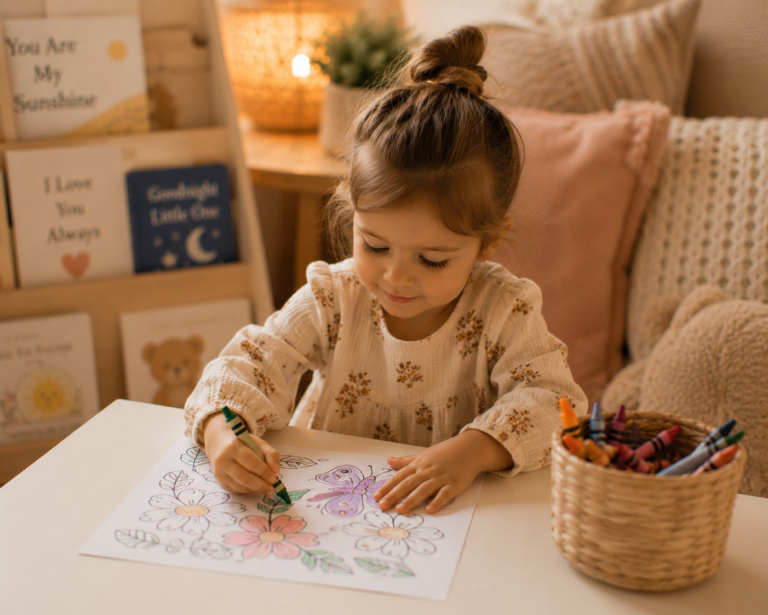
This is the ultimate low-prep screen-free toddler activity, and it’s genuinely developmental. Coloring builds hand control, color recognition, and the habit of focused, quiet work. Simple coloring pages with large outlines and familiar subjects (animals, shapes, fruits) are ideal for ages 2–4.
Our toddler coloring worksheets are designed with exactly this age range in mind — large, clear outlines that are satisfying to color without being overwhelming.
Keep a low drawer or basket stocked with crayons, a few worksheets, stickers, and simple coloring pages. When your toddler needs something to do, point to the drawer and let them choose. Having it always ready — no setup required — means you can offer a screen-free option in under 10 seconds, even on your hardest days.
Playdough and Sculpting
Few activities match playdough for sheer developmental value per minute. Rolling, squeezing, poking, and flattening builds the exact hand strength that later supports writing and scissor use. Add simple tools — plastic forks, rolling pins, cookie cutters — and a 2-year-old can be productively occupied for a surprisingly long time. You can make playdough at home in under ten minutes with flour, salt, water, and food coloring if you prefer to avoid store-bought.
Toddler Worksheets for Independent Focus Time
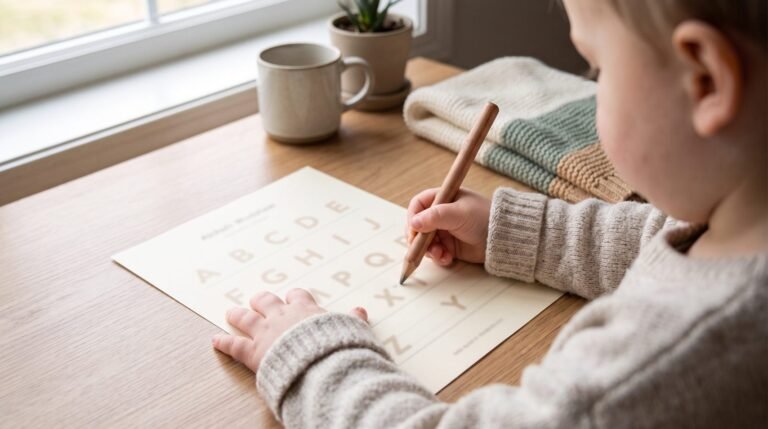
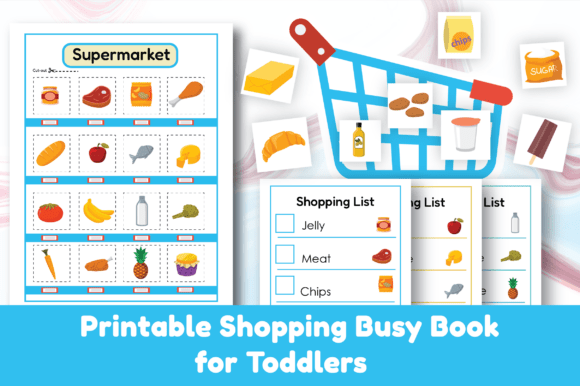
When you need your toddler to be independently occupied for a short stretch — during a call, while cooking, or just when you need five quiet minutes — simple printable activities are remarkably effective. The best ones for this age are tracing pages, simple matching sheets, and coloring activities that require just enough focus to hold attention without being frustrating.
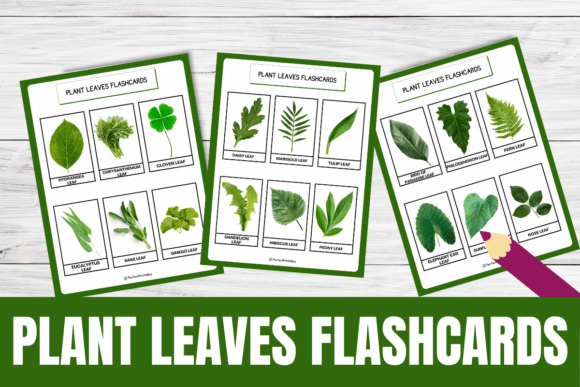
Our toddler matching activities combine visual engagement with gentle fine motor practice — perfect for that independent focused stretch.
Water Play
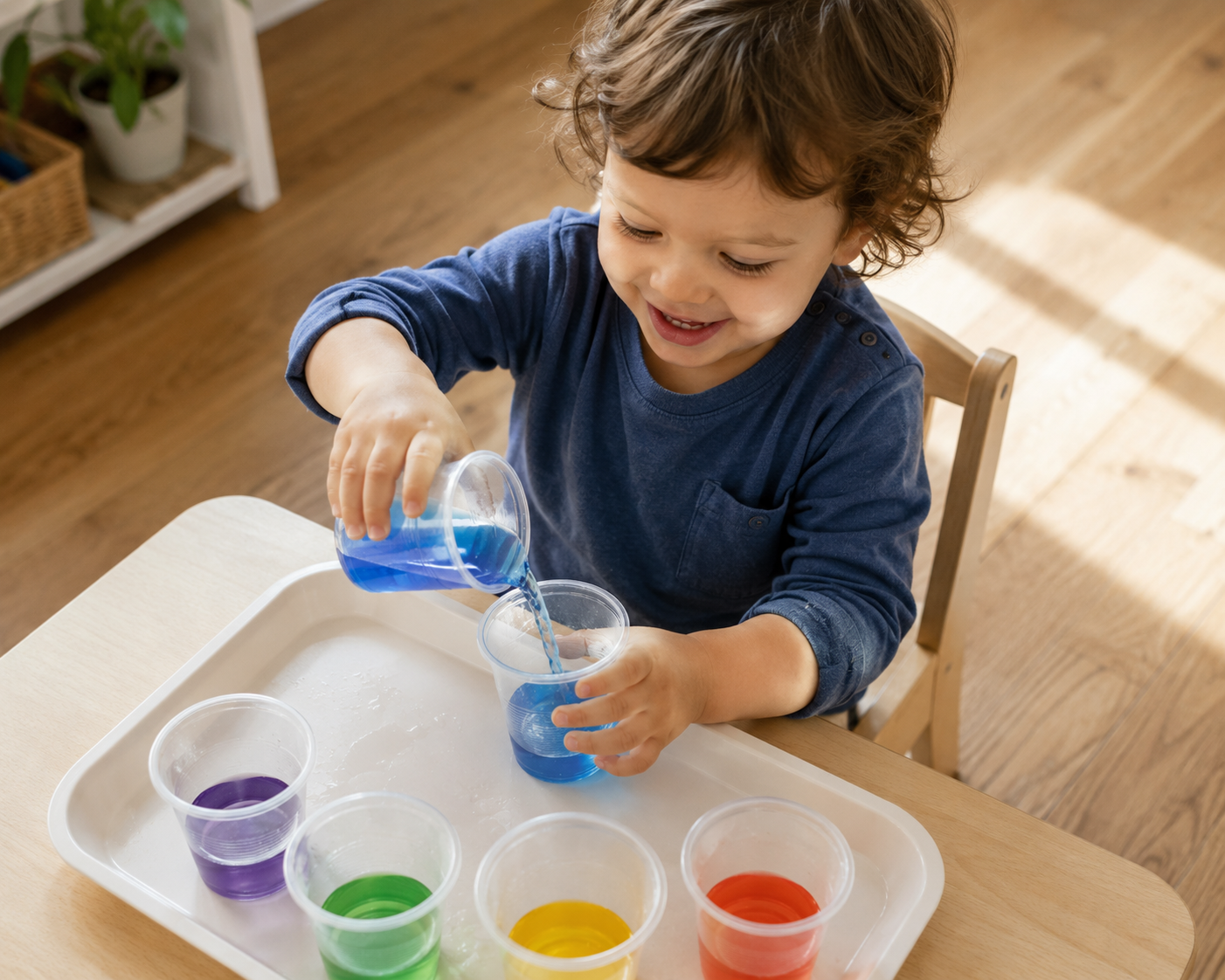
A plastic bin, some water, and a few cups. Maybe some sponges or small toys. Toddlers are genuinely fascinated by water — pouring, splashing, squeezing — and this kind of play builds spatial reasoning, hand-eye coordination, and basic physics understanding in a completely natural way. Outdoor version: splash pad or a shallow paddling pool. Indoor version: the sink with supervision.
Simple Puzzles and Shape Sorters
These are some of the most developmentally rich no-screen activities for toddlers, and most families already own several that are buried under a pile of other toys. Wooden peg puzzles (4–8 pieces) are ideal for ages 2–3. Slightly more complex puzzles (10–20 pieces) suit ages 3–4. Shape sorters build spatial reasoning and hand-eye coordination simultaneously.
Making Screen-Free Time a Habit (Without Making It a Battle)
The families who succeed with screen-free toddler time usually aren’t the ones with the strictest rules — they’re the ones with the most accessible alternatives. When a child reaches for a screen, it’s usually because they’re bored and the screen is the easiest thing available. The solution isn’t saying no — it’s making yes easier.
- Keep supplies accessible. Low shelves with puzzles, crayons, playdough, and worksheets — all reachable without asking a parent.
- Rotate toys. Putting half the toys away and rotating every few weeks makes familiar toys feel new again.
- Sit with them to start. Even five minutes of joining an activity before stepping away dramatically increases how long a toddler will stay engaged independently.
- Don’t fight the screen battle publicly. “The iPad is sleeping right now — let’s find something else” works better than “no screens.”

A Simple Screen-Free Activity Starter Kit
You don’t need to buy anything new. Here’s what a useful screen-free toolkit looks like — most of it you probably already have:
- Chunky crayons and a few coloring sheets (print from home)
- A container of playdough and two or three simple tools
- One age-appropriate puzzle (4–12 pieces depending on age)
- A sensory bin (tray + dry rice or pasta + a spoon)
- 5–10 printed toddler worksheets kept in a folder or drawer
- A simple matching game or shape sorter
- A few board books within reach at all times
Conclusion
Screen-free activities for toddlers don’t have to be elaborate, educational, or Instagram-worthy to matter. A rice bin on the kitchen floor. A coloring page pulled from a folder. Five minutes with playdough while you make dinner. These moments add up to something real — stronger hands, longer attention, richer language, and a child who knows how to entertain themselves without a screen doing it for them.
You don’t have to be a perfect, screen-free parent. You just have to make the alternatives a little more accessible than the default. That’s enough. And on the days when the tablet wins anyway — that’s okay too. Tomorrow is another rice bin waiting to happen.
Frequently Asked Questions
How much screen-free time should toddlers have each day?
The American Academy of Pediatrics recommends avoiding screens entirely for children under 18 months (except video calls) and limiting screen time to one hour per day of high-quality programming for children aged 2–5. That said, the goal isn’t to count minutes obsessively — it’s to make sure a meaningful portion of each day involves hands-on, active, or imaginative play.
My toddler won’t do any activity for more than two minutes. Is that normal?
Completely normal, especially under age 3. Toddler attention spans are short by design — their brains are scanning and exploring rather than settling and focusing. The key is having many short activities available rather than expecting one to last a long time. As children move toward age 3–4, sustained focus naturally develops, especially with activities they find genuinely interesting.
What are the best screen-free activities for a toddler who hates sitting still?
High-movement options work best: sensory bins they can reach into, water play, playdough squishing, large-format floor puzzles, and indoor obstacle courses made from pillows. These channel physical energy into productive play without requiring sitting. As their focus develops, quieter activities become more accessible.
Are toddler worksheets really educational, or are they just busy work?
When age-appropriate and low-pressure, toddler worksheets build real skills: fine motor control through tracing and coloring, early logic through matching and sorting, and the habit of focused, independent work. The key words are “age-appropriate” and “low-pressure.” A two-year-old doing a simple tracing page is building genuine skills. A two-year-old being pressured to complete a complex worksheet is just being frustrated.
How do I handle screen-free time when I need to get things done?
The most effective strategy is setting up an activity before you step away — even briefly joining for two or three minutes dramatically increases how long a child stays engaged independently. A pre-stocked “yes drawer” or low shelf with accessible materials also helps enormously, because it gives children a self-serve option rather than requiring you to set something up mid-task.
What screen-free activities work for toddlers with shorter attention spans?
Sensory play (rice bins, water, playdough) consistently holds attention longer than almost anything else for young toddlers. Open-ended materials — things with no “right way” to use them — tend to hold attention better than structured activities for children who resist staying on task. Rotating activities every few days also helps: familiar-but-refreshed materials feel new again and recapture interest naturally.
Related reading
- Calm and Quiet Activities for Toddlers and Preschoolers
- Best Rainy Day Learning Activities for Kids
- Homeschool Learning Ideas for Preschoolers That Actually Work
- Simple Fine Motor Activities for Preschoolers That Build Real Skills