Simple Fine Motor Activities for Preschoolers That Build Real Skills
If your preschooler struggles to hold a pencil, gets frustrated with buttons, or avoids activities that require careful hand control — you’re not imagining it, and you’re not alone. Fine motor skills don’t develop on their own just because a child gets older. They develop through use. Through squeezing, pinching, cutting, threading, and all the small hand-intensive activities that preschoolers need far more of than most of us realize.
The good news is that fine motor activities for preschoolers don’t require special equipment or a therapist’s office. Most of the best ones use things you already have at home. And when you want something structured and printable for focused practice, our fine motor skills worksheets are designed to make that easy. But let’s start with the fundamentals — what fine motor skills actually are, and why they matter so much at this age.

What Fine Motor Skills Actually Are — and Why Preschool Is the Critical Window
Fine motor skills are the small, precise movements made by the hands and fingers — as opposed to gross motor skills, which involve the larger movements of arms, legs, and the whole body. In practical terms, fine motor skills are what a child uses to hold a pencil, button a coat, use scissors, pick up small objects, turn pages in a book, and eventually type on a keyboard.
Child development experts identify the preschool years — roughly ages 3 to 5 — as the most critical window for fine motor development. During this period, the small muscles of the hand are maturing rapidly, and the neural connections between the brain and the fingers are being established at a pace that won’t be matched again. That’s why preschool fine motor practice during these years has such an outsized impact on later skills like handwriting, drawing, and self-care independence.
Fine Motor Skill Development by Age
| Age | Typical Fine Motor Milestone | Activities That Help |
|---|---|---|
| 2–3 years | Scribbling, stacking blocks, turning pages, simple puzzles | Playdough, large bead threading, chunky crayons, stacking toys |
| 3–4 years | Cutting with scissors (with help), drawing circles, holding pencil with fingers | Scissor practice, tracing lines, lacing cards, tongs and tweezers play |
| 4–5 years | Cutting on a line, drawing basic shapes, writing some letters | Cut and paste activities, letter tracing, fine motor worksheets, bead threading |
| 5–6 years | Writing name, buttoning independently, drawing recognizable pictures | Writing practice, detailed coloring, small bead threading, origami |
The Best Fine Motor Activities for Preschoolers at Home
These are organized from the simplest to slightly more structured — all low-prep, all genuinely effective for building preschool fine motor practice.
Playdough — The Single Best All-Round Activity
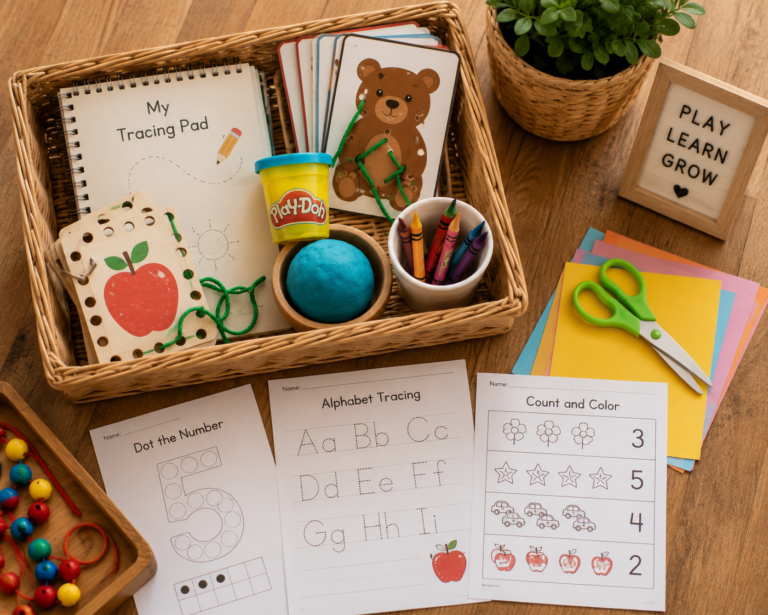
If you could only pick one fine motor activity for a preschooler, playdough would win. Rolling, squeezing, pinching, poking, and flattening it builds the intrinsic hand muscles — the small muscles inside the palm — that are directly responsible for pencil control. Add tools like toothpicks, plastic forks, rolling pins, and cookie cutters, and you extend both the engagement and the developmental value significantly.
Tongs, Tweezers, and Clothespins
These are some of the most underrated easy fine motor ideas for preschoolers. Give a child a pair of kitchen tongs and a bowl of pompoms to transfer from one container to another. Or use spring-style clothespins to clip onto the edge of a box. The squeezing motion required directly strengthens the same pincer grip used to hold a pencil — and most children find these activities genuinely fun in a way that feels more like a game than practice.
Set out two small bowls and a pile of pompoms or small pom-poms. Give your preschooler a pair of kitchen tongs or child-safe tweezers and ask them to move every pompom from one bowl to the other. Start with larger pompoms and progress to smaller ones as hand strength develops. Early childhood educators use variations of this activity constantly — it’s simple, engaging, and highly effective for preschool hand coordination.
Lacing Cards and Bead Threading
Threading laces through holes in cardboard cards, or stringing beads onto a cord, requires the precise two-finger pinch that directly transfers to pencil holding. Large wooden beads on a thick cord are appropriate for ages 2–3. Smaller beads on a thinner lace suit ages 4–5. These toddler fine motor activities build concentration alongside hand skill — there’s something about the focused, repetitive nature of threading that genuinely absorbs young children.
Scissor Practice
Learning to use scissors is one of the most complex fine motor tasks a preschooler tackles, and it deserves its own dedicated practice time. Start with cutting play dough snakes (no paper needed, great for building scissor strength). Progress to cutting fringe on paper, then cutting along straight lines, then curves. Child-safe scissors with a spring mechanism are easiest for beginners and reduce frustration significantly.
Cut and Paste Activities
Cut and paste activities combine two fine motor skills in one session — scissor control and precise gluing — which makes them especially valuable for ages 4 and up. They also produce a finished product the child is proud of, which keeps motivation high. Our cut and paste worksheets are designed with preschoolers in mind — clear cutting lines, manageable piece sizes, and engaging themes that make the work feel purposeful.
Fine Motor Worksheets for Structured Practice
When you want to give preschool fine motor practice a more focused, structured form — especially for children approaching kindergarten age — printable fine motor worksheets fill that role well. Tracing dotted lines, connecting dots, coloring within boundaries, and cutting along paths all build the specific hand control that writing requires.
The key is keeping sessions short (10–15 minutes) and genuinely low-pressure. The goal is building skill and confidence — not completing a page perfectly.

Hand Strengthening Activities for Everyday Moments
Fine motor skills don’t only develop at the table. These everyday moments build the same hand strength as structured activities — without any setup required:
- Squeezing a sponge during bath time or while washing dishes together
- Opening and closing containers — jars with twist lids, zipper bags, snap-close boxes
- Tearing paper — tearing newspaper or scrap paper into small pieces for a collage
- Kneading dough during baking together
- Using spray bottles — watering plants with a spray bottle is surprisingly great for hand strengthening
- Picking up small objects — coins, buttons, small stones sorted into groups

A Simple Fine Motor Routine for Home
You don’t need to do all of this every day. Here’s a gentle weekly rhythm that covers the key skill areas without overwhelming anyone:
- Playdough for 10–15 minutes at least 3 times this week
- One tongs or tweezers transfer activity
- One cutting practice session (playdough snakes or paper fringe)
- One fine motor worksheet — tracing, connecting dots, or coloring within lines
- One everyday hand-strengthening moment (spray bottle, kneading, tearing paper)
- One threading or lacing activity if your child is ready
Conclusion
Fine motor activities for preschoolers don’t need to look like therapy or school. They can look like playdough on a Tuesday afternoon, pompoms being transferred from bowl to bowl with a pair of kitchen tongs, or a child carefully watering a plant with a spray bottle she’s claimed as her own.
The small muscles in your child’s hands are being built right now — in these ordinary, everyday moments. Every squeeze of playdough, every careful snip with scissors, every bead threaded onto a lace is laying groundwork for the pencil control, the writing confidence, and the fine hand independence they’ll rely on for years to come.
You don’t need to do it perfectly. You just need to do a little, consistently. And little by little, those small hands will surprise you with what they can do.
Frequently Asked Questions
What are the most important fine motor skills for preschoolers to develop?
The most foundational fine motor skills for preschoolers are: pincer grip (picking up small objects with thumb and index finger), hand strength (squeezing, kneading, gripping), bilateral coordination (using both hands together), scissor control, and pencil/crayon grip. These skills underpin writing, drawing, cutting, and self-care tasks like buttoning and zipping.
How do I know if my preschooler has fine motor delays?
Some signs to watch for: significant difficulty holding a crayon or pencil at age 4+, inability to use child-safe scissors with any control by age 4–5, very low hand strength compared to peers, avoiding all hand-intensive activities, or extreme frustration with tasks other children the same age find manageable. If you have concerns, an occupational therapist who works with young children can provide a proper assessment and specific guidance.
Are fine motor worksheets appropriate for 3-year-olds?
Simple fine motor worksheets — thick-lined tracing pages, large dot-to-dot activities, chunky coloring pages — are appropriate for many 3-year-olds, especially those who show interest. The key is matching the difficulty to where the child actually is, keeping sessions short (5–10 minutes), and keeping the experience positive. If a 3-year-old shows frustration or avoidance, dial back to purely play-based fine motor activities and reintroduce worksheets a few months later.
How much fine motor practice does a preschooler need each day?
There’s no magic number, but early childhood educators generally recommend that preschoolers engage in some form of fine motor activity for at least 15–20 minutes daily. This doesn’t have to be structured — playdough, drawing, building with small blocks, and helping with simple cooking tasks all count. The goal is consistent, varied hand use across the day rather than one intensive session.
What’s the best way to improve pencil grip in a preschooler?
Building general hand strength through activities like playdough, tongs play, and lacing cards is the most effective foundation. Triangular or chunky writing tools naturally encourage a better grip position. Avoid forcing grip correction directly — model the correct hold, offer the right tools, and let strength and habit develop naturally over time. Specific pencil grip activities are covered in detail in our article on handwriting readiness.
Can fine motor activities help with handwriting readiness?
Absolutely — fine motor skill development and handwriting readiness are deeply connected. Children who have strong pincer grip, good hand strength, and experience with controlled movements (tracing, cutting, threading) almost always find letter formation significantly easier when it’s introduced. Building fine motor skills first is the most effective preparation for writing — far more effective than jumping straight to letter practice before the hand is ready.
Related reading
- Easy Cutting Activities for Preschoolers Ages 3–5
- How to Improve Pencil Grip in Young Children
- Why Tracing Activities for Preschoolers Matter Before Writing
- Easy Learning Games for Preschoolers at Home