Helping Young Kids Name Their Feelings (Ages 2-6)
You know the moment. Your three-year-old is melting down on the kitchen floor over the wrong-colored cup, and no amount of reasoning is landing. In that instant, they don’t have the words for what’s happening inside them, and honestly, most of us didn’t get taught those words either. Helping kids name their feelings is one of the quietest, most useful things we can do as parents, and it doesn’t require a single perfect sentence.
This isn’t about raising a child who never falls apart. Big feelings are supposed to happen in these early years. What we’re doing is slowly handing our kids a vocabulary, so that over time the floor-meltdown becomes “I’m so mad.” That shift takes years, and it’s built one ordinary moment at a time.
Why naming feelings helps kids manage them
When a young child feels a wave of anger or fear, it’s physical first: a racing heart, hot cheeks, clenched fists. Without a word to attach to that sensation, the feeling can feel enormous and endless. Giving it a name — “That’s frustration” — does something surprisingly powerful. It turns a formless storm into something with edges, something a child can begin to recognize and, eventually, talk about instead of act out.
Researchers sometimes call this “name it to tame it,” and while it sounds like a slogan, the everyday version is simple. A child who can say “I’m scared of the dark” is far easier to comfort than one who can only scream. Naming doesn’t erase the feeling — your child will still be scared — but it opens a door to connection. You’re no longer guessing; you’re responding to something real and shared.
There’s a second quiet benefit. Every time you name a feeling calmly, you’re teaching your child that emotions aren’t dangerous or shameful. Sadness is allowed. Anger is allowed. The feeling itself is never the problem; it’s just information. That message, repeated across hundreds of small moments, becomes the foundation of emotional regulation later on.
What to expect by age: 2, 3, 4, and 5-6
Emotional vocabulary grows in stages, and knowing roughly what’s typical can take the pressure off. Here’s a realistic picture — not a checklist to worry over, just a map.
- Age 2: Toddlers feel emotions intensely but have very few words for them. Most two-year-olds can recognize and maybe say “happy,” “sad,” and “mad,” often after you’ve named them many times. Their feelings arrive fast and pass fast. Don’t expect self-control here — expect big waves, and expect to be the one supplying the words.
- Age 3: Feelings words for toddlers really start to expand around now. A three-year-old may name “scared,” “tired,” and “excited,” and can sometimes tell you how they feel after the storm has passed, though rarely during it. They’re beginning to notice feelings in others too — a friend crying may prompt a concerned look.
- Age 4: Preschoolers can often use a handful of feelings words accurately and may start describing why they feel something (“I’m sad because we left the park”). Teaching feelings to preschoolers at this age works beautifully because they’re genuinely curious about their inner world. Expect drama, imagination, and a growing ability to pause — briefly — before reacting.
- Ages 5-6: Kindergarten-age children can name a wider emotional vocabulary, including trickier feelings like “jealous,” “nervous,” “embarrassed,” and “disappointed.” They can begin to talk through a feeling instead of only showing it, and they’re starting to understand that two feelings can happen at once. Regulation is still very much a work in progress — and that’s completely normal.
If your child is a little behind this sketch, that’s okay. Kids develop language on their own timelines, and emotional words often come later than words for objects and actions. Your steady modeling matters more than hitting any particular milestone on schedule.
Starting with the core four (happy, sad, mad, scared)
When you’re building emotional vocabulary for kids, resist the urge to teach fifteen feelings at once. Start with four: happy, sad, mad, and scared. These four are concrete, they show up constantly in daily life, and they’re easy for even a two-year-old to connect to a face and a body sensation.
The trick is to name these feelings out loud as they actually happen, in real time. “You’re so happy the dog is home!” “You look sad that story ended.” “You’re mad that it’s bath time.” “That loud truck made you scared.” You’re essentially narrating your child’s inner life until they can narrate it themselves. It feels repetitive to you; to them, it’s language immersion.
Once the core four feel solid — usually after months of practice, not days — you can gently layer in nearby feelings. “Mad” branches into frustrated, annoyed, and grumpy. “Scared” branches into nervous and worried. “Sad” branches into lonely and disappointed. Add these slowly, and always anchor the new word to a real moment your child is living, not an abstract lesson.
Everyday moments to build feelings vocabulary
You don’t need a curriculum for this. The best emotional-vocabulary practice is woven into the day you’re already having. Here are moments that work especially well:
- Reading books together: Pause on a page and ask, “How do you think she feels?” Picture books are full of expressive faces and give kids a low-stakes way to practice reading emotions in someone else.
- During pretend play: When the teddy bear is “sad” or the toy dinosaur is “mad,” your child is safely rehearsing feelings. Join in and name what the characters feel.
- After a tricky moment: Once everyone is calm again, gently revisit it. “Earlier you were really frustrated when the tower fell. That’s a hard feeling.” Reflecting afterward, when the nervous system is settled, is often where the real learning sticks.
- In wind-down time: A slow, unhurried part of the day is perfect for feelings talk. Pairing emotional conversations with calm and quiet activities gives kids the settled headspace to actually reflect rather than react.
- At the end of the day: A simple “What was a happy part and a hard part of today?” builds the habit of noticing feelings. Some families fold this into a bedtime routine or a gentle gratitude journal for kids, which naturally pulls emotional words into everyday reflection.
None of these need to be long. Thirty seconds of naming a feeling, sprinkled through the day, adds up to far more than one big “let’s talk about our emotions” conversation ever could.
Using charts and pictures to make feelings visible
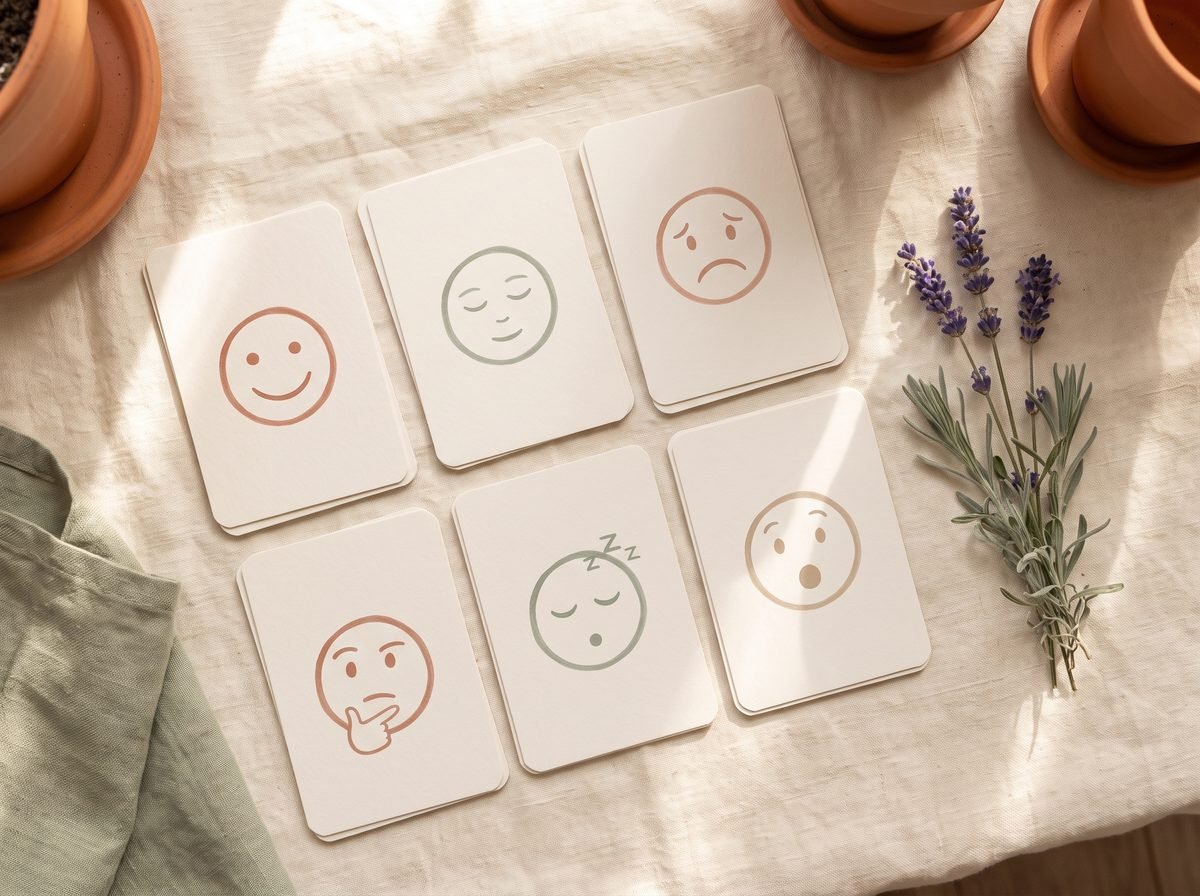
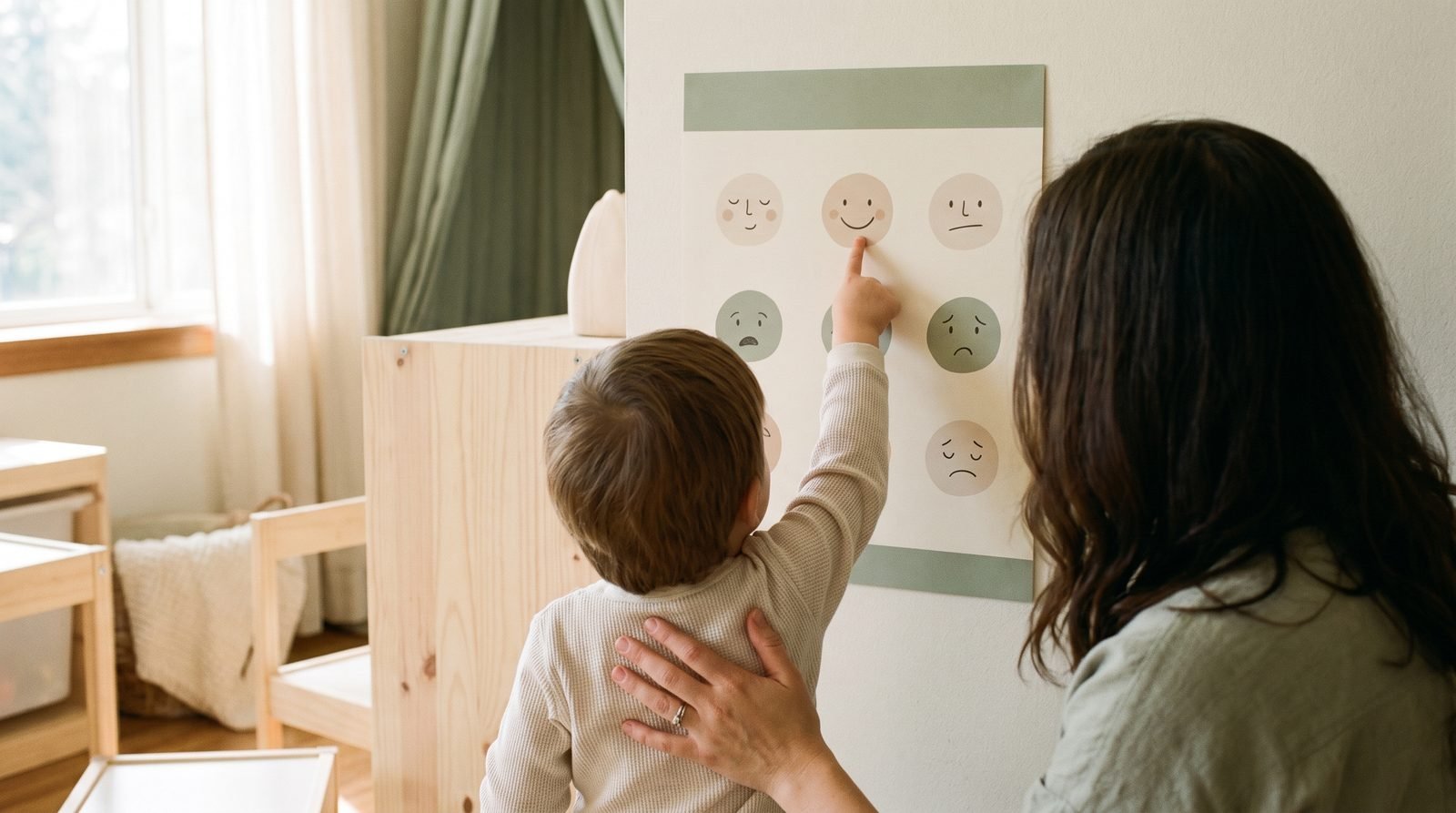
Young children are visual, and feelings are invisible — which is exactly why pictures help so much. A simple chart with a few faces gives your child something to point to when words are hard to find, especially in the middle of a big feeling when talking is nearly impossible.
Keep it simple at first. A small set of clear faces — happy, sad, mad, scared — mounted somewhere at your child’s eye level works better than an overwhelming grid of twenty subtle expressions. During a calm moment, walk over together and talk about each face: “This one’s mouth is turned down. When do we feel like that?” Then, when a real feeling hits, you can say, “Can you show me which face fits right now?”
Printable tools make this easy to set up at home. A set of printable emotion charts gives you ready-made faces to point to, and hands-on feelings worksheets for kids let children practice matching faces to situations at a relaxed, no-pressure pace. The goal isn’t to “complete” anything — it’s to give feelings a shape your child can see and touch.
Modeling your own feelings out loud
Here’s the part that does the heaviest lifting: your child learns emotional language mostly by watching you use it. When you name your own feelings, calmly and without drama, you show them that even grown-ups have big emotions and can talk about them safely.
This doesn’t mean burdening your child with adult stress. It means small, honest narration: “I’m feeling a little frustrated that we’re running late, so I’m going to take a deep breath.” “I felt so happy when you gave me that hug.” You’re demonstrating the whole cycle — noticing a feeling, naming it, and choosing a response — in a way no worksheet can match.
Gentle scripts for tricky emotions
When you’re not sure what to say in the heat of the moment, a few simple, repeatable phrases help. These aren’t magic words; they’re calm anchors you can lean on:
- For anger: “You’re really mad right now. It’s okay to feel mad. I won’t let you hit — let’s stomp our feet instead.”
- For fear: “That felt scary. I’m right here with you. Your body is safe.”
- For sadness: “You’re sad it’s over. That makes sense. I’ll sit with you for a minute.”
- For frustration: “This is really hard, and you’re frustrated. Do you want to try again or take a break?”
- For overwhelm: “That was a lot of feelings all at once. Let’s slow down and breathe together.”
Notice the pattern: name the feeling, accept it, then offer a next step. You’re not fixing the emotion or arguing it away — you’re standing beside your child inside it.
What not to say (dismissing vs. acknowledging)
Most of us grew up hearing well-meaning phrases that quietly taught us to hide feelings, and they slip out easily. It helps to notice the difference between dismissing a feeling and acknowledging it:
- Instead of “You’re fine, stop crying,” try “Something upset you. I’m listening.”
- Instead of “Don’t be scared, there’s nothing to be afraid of,” try “That felt scary to you. I’m here.”
- Instead of “Big kids don’t get mad about that,” try “You’re allowed to be mad. Let’s figure out what to do with it.”
- Instead of “It’s not a big deal,” try “It’s a big deal to you, and that matters.”
You won’t get this right every time, and you don’t need to. Acknowledging a feeling doesn’t mean approving of every behavior — you can hold a limit (“no hitting”) while still honoring the emotion underneath it. The message that lands over time is simply: your feelings are real, and I can handle them with you.
Building a feelings vocabulary is slow, unglamorous work, and it unfolds over years, not weeks. But every time you name a feeling, offer a calm face to point to, or narrate your own quiet frustration, you’re handing your child a tool they’ll use for the rest of their life. You don’t have to be perfect at it. You just have to keep showing up, one ordinary feeling at a time.
Making a Feelings Chart That Lasts
A feelings chart gets handled every day. Laminating it and adding hook-and-loop dots lets a child move a marker to today's feeling.
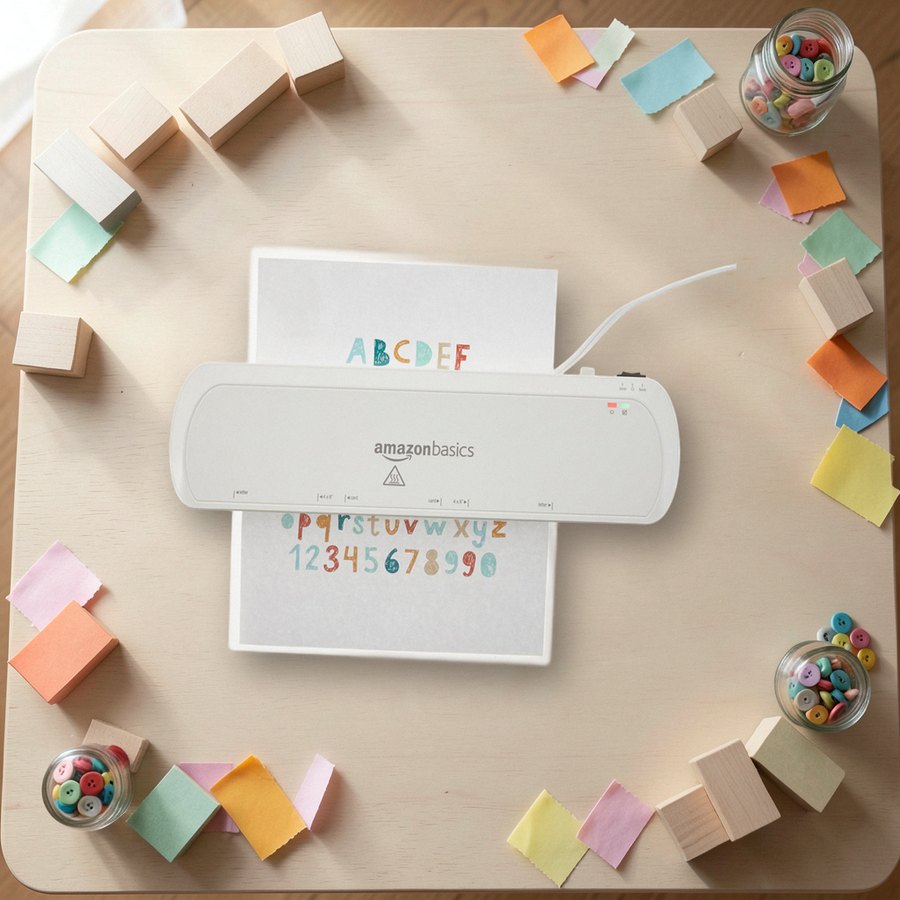 9-inch thermal laminatorView on Amazon
 Laminating pouches, 3 milView on Amazon
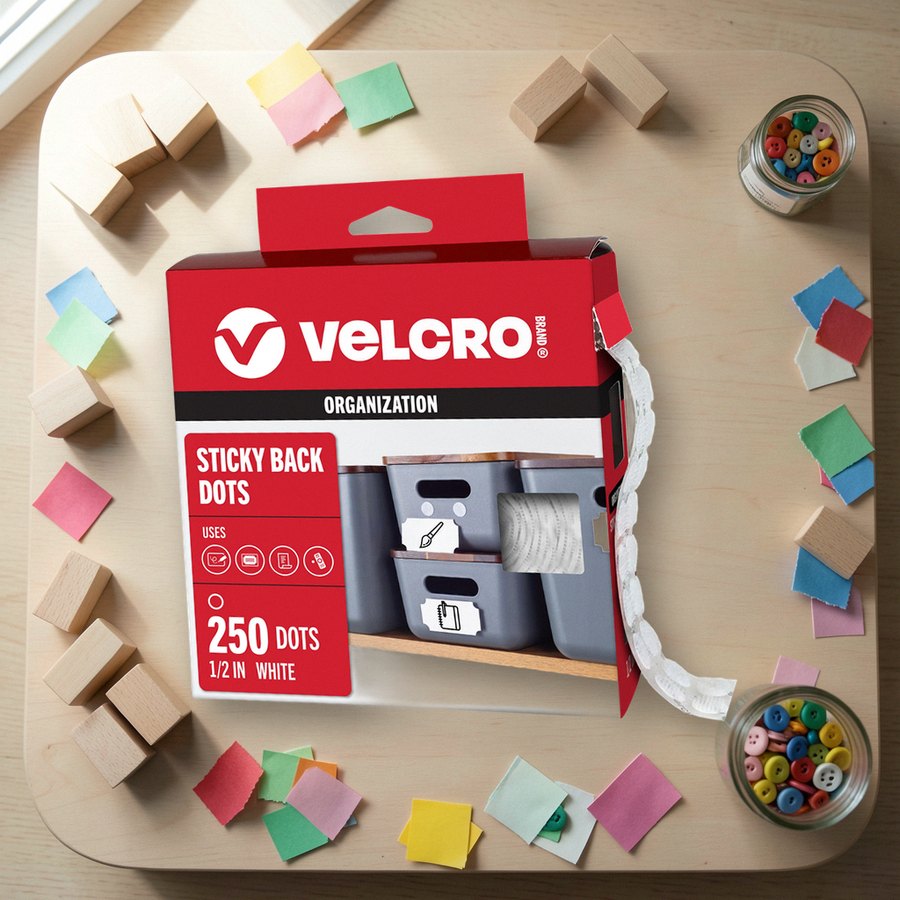 Adhesive hook-and-loop dotsView on Amazon
As an Amazon Associate, PrintableBloom earns from qualifying purchases.